
In industrial welding, maintaining consistent weld quality is essential for safety, reliability and compliance with engineering standards. Industries such as oil and gas, pressure vessel manufacturing, power generation and structural fabrication rely on strict welding codes to ensure that welded components perform safely under demanding conditions.
One of the most important standards governing welding qualifications is ASME Section IX, which is part of the ASME Boiler and Pressure Vessel Code (BPVC).
ASME Section IX defines how welding procedures and welders must be qualified before production welding begins. Within this code, a critical concept is the classification of welding parameters into essential variables, non-essential variables and supplementary essential variables.
Understanding these variables is crucial when developing or modifying a Welding Procedure Specification (WPS) because certain changes may require the welding procedure to be requalified.
What Are Essential Variables in Welding?
In ASME Section IX, essential variables are welding parameters that significantly affect the mechanical properties and performance of a weld.
If an essential variable is changed beyond the limits specified in the qualified welding procedure, the procedure must be requalified through additional testing.
This requirement ensures that welding procedures continue to produce welds with acceptable strength, toughness and reliability.
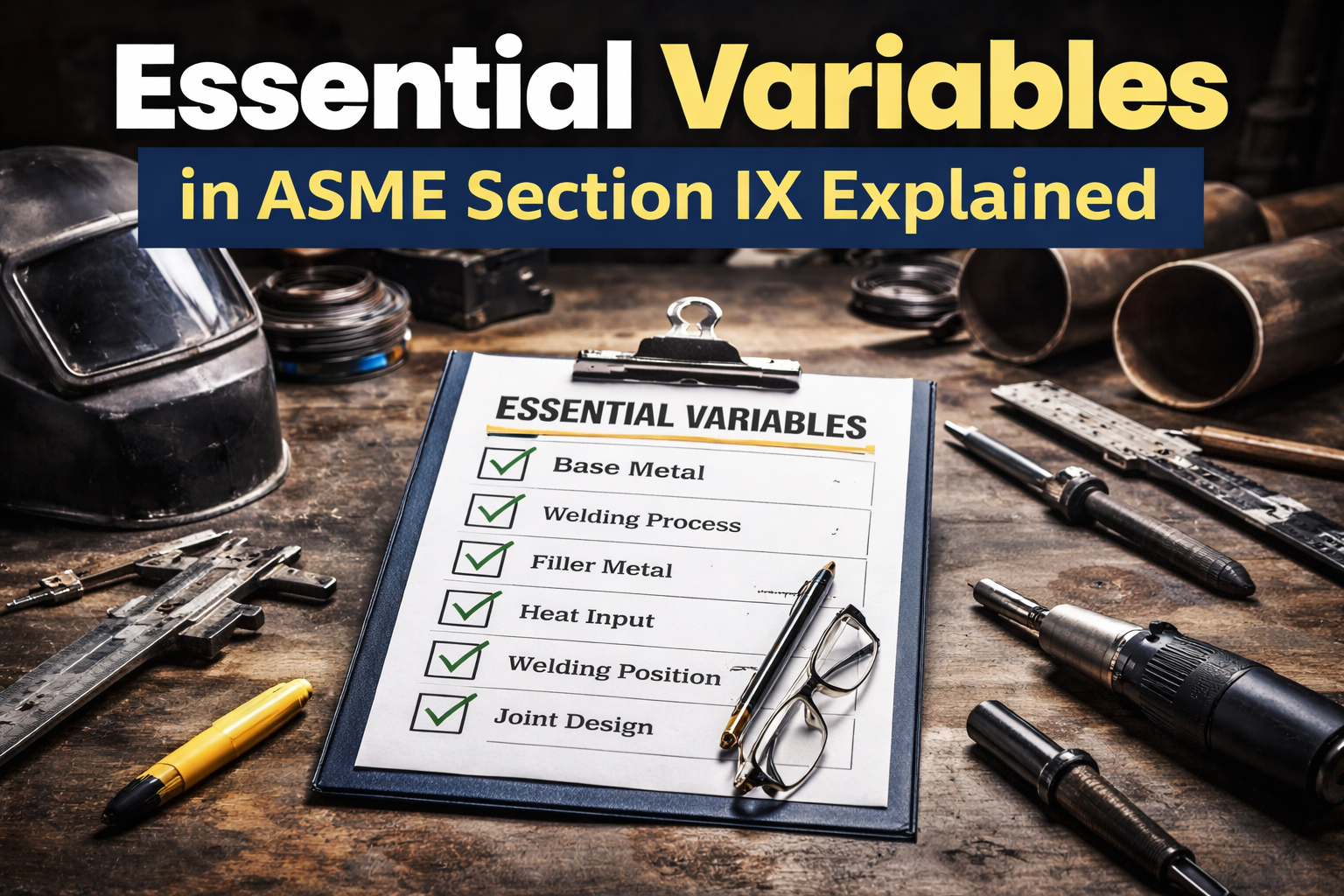
Examples of parameters considered essential variables include:
Base metal type
Welding process
Filler metal classification
Heat input
Welding position
Joint design
These variables directly influence the metallurgical properties of the weld and the overall structural integrity of the welded component.
Why Essential Variables Are Important
Essential variables ar e critical because they help maintain the consistency and reliability of welding procedures.
Ensuring Weld Quality
By controlling essential variables, engineers ensure that welding procedures consistently produce welds with acceptable mechanical properties.
Preventing Welding Defects
Changes in welding parameters can lead to defects such as cracking, porosity, or incomplete fusion. Essential variable requirements help minimize these risks.
Maintaining Code Compliance
ASME Section IX requires welding procedures to remain within qualified limits. Any change to essential variables requires new qualification testing to verify weld performance.
Protecting Structural Integrity
Welded structures used in pressure vessels, pipelines, and power plants must withstand high loads and extreme conditions. Controlling essential variables ensures the welds maintain the required strength and durability.
Types of Variables in ASME Section IX
ASME Section IX classifies welding variables into three categories.
Essential Variables
Essential variables directly affect the mechanical properties of the weld.
If these variables are changed beyond specified limits, the welding procedure must be requalified using a new Procedure Qualification Record (PQR).
Examples include:
Change in welding process (e.g., SMAW to TIG)
Change in base metal group
Change in filler metal classification
Change in welding position
Change in heat input
Because these parameters affect weld strength and structure, strict control is required.
Non-essential Variables
Non-essential variables do not significantly affect the mechanical properties of the weld.
If these variables change, the welding procedure does not require requalification but the Welding Procedure Specification (WPS) must still be updated.
Examples of non-essential variables include:
Cleaning methods
Joint preparation details
Backing materials
Electrode storage conditions
Although they may not require requalification, these variables are still important for maintaining proper welding practices.
Supplementary Essential Variables
Supplementary essential variables become important when impact testing is required for a welding procedure.
Impact testing evaluates the toughness of the weld especially in applications where materials are exposed to low temperatures or dynamic loads.
Examples include:
Heat input limits
Welding technique changes
Post weld heat treatment parameters
When impact testing is required, these variables must also remain within qualified limits.
Relationship Between Essential Variables and WPS
Essential variables are closely connected to the Welding Procedure Specification (WPS).
A WPS provides instructions on how welding must be performed during production. These instructions are based on parameters that were tested and verified during the Procedure Qualification Record (PQR).
If any essential variable is changed beyond the qualified range, the WPS is no longer valid and a new qualification test must be performed.
This ensures that welding procedures continue to meet the requirements of ASME Section IX.
Examples of Essential Variable Changes
To better understand how essential variables affect welding procedures, consider the following examples.
Change in Welding Process
Switching from Shielded Metal Arc Welding (SMAW) to Gas Tungsten Arc Welding (TIG) would require a new qualification test.
Change in Base Metal
Using a different base metal group may affect weld strength and metallurgical properties.
Change in Welding Position
Changing from flat position to vertical or overhead welding may affect weld penetration and quality.
Change in Heat Input
Heat input affects the cooling rate and microstructure of the weld, which can influence mechanical properties.
Industries That Depend on ASME Section IX
ASME welding qualification standards are widely used in industries where weld quality is critical.
These industries include:
Oil and gas pipelines
Pressure vessel manufacturing
Shipbuilding and offshore platforms
Power plants and energy facilities
Petrochemical processing plants
Heavy industrial fabrication
In these sectors, proper control of welding variables is essential for maintaining safety and compliance with engineering standards.
Conclusion
Essential variables play a crucial role in maintaining the integrity and reliability of welding procedures under ASME Section IX. By identifying which welding parameters significantly affect weld performance, the code ensures that any important changes are properly tested and verified.
Understanding essential variables helps welding engineers, inspectors and fabricators maintain compliance with industry standards while ensuring consistent weld quality.
For organizations involved in welding training, fabrication and quality control, mastering the concepts of essential variables, non-essential variables and supplementary essential variables is an important step toward achieving reliable and compliant welding operations.
ASME Section IX Essential Variables Dijelaskan Secara Mudah
Dalam industri kimpalan, mengekalkan kualiti kimpalan yang konsisten adalah sangat penting bagi memastikan keselamatan, kebolehpercayaan, dan pematuhan kepada piawaian kejuruteraan.
Industri seperti minyak & gas, pembuatan pressure vessel, penjanaan tenaga, dan fabrikasi struktur sangat bergantung kepada kod kimpalan yang ketat bagi memastikan komponen yang dikimpal berfungsi dengan selamat dalam keadaan operasi yang mencabar.
Salah satu piawaian paling penting ialah ASME Section IX, yang merupakan sebahagian daripada ASME Boiler and Pressure Vessel Code (BPVC).
ASME Section IX menetapkan bagaimana prosedur kimpalan dan pengimpal perlu disahkan (qualified) sebelum kerja kimpalan sebenar dijalankan. Dalam kod ini, terdapat konsep penting iaitu pengelasan parameter kimpalan kepada:
- Essential variables (pembolehubah penting)
- Non-essential variables (pembolehubah tidak penting)
- Supplementary essential variables (pembolehubah tambahan penting)
Memahami pembolehubah ini sangat penting apabila membangunkan atau mengubah Welding Procedure Specification (WPS) kerana perubahan tertentu mungkin memerlukan prosedur kimpalan diuji semula (requalification).
Apakah Essential Variables dalam Kimpalan?
Dalam ASME Section IX, essential variables ialah parameter kimpalan yang memberi kesan besar kepada sifat mekanikal dan prestasi kimpalan.
Jika pembolehubah ini berubah melebihi had yang ditetapkan dalam prosedur yang telah diluluskan, maka prosedur tersebut perlu dijalankan semula ujian kelayakan (requalification).
Ini memastikan bahawa kimpalan yang dihasilkan mempunyai:
- Kekuatan yang mencukupi
- Ketahanan yang baik
- Kebolehpercayaan yang tinggi
Contoh Essential Variables
- Jenis logam asas (base metal)
- Proses kimpalan
- Jenis filler metal
- Input haba (heat input)
- Kedudukan kimpalan
- Reka bentuk sambungan
Pembolehubah ini memberi kesan langsung kepada sifat metalurgi dan kekuatan struktur sambungan kimpalan.
Kenapa Essential Variables Penting?
1. Menjamin Kualiti Kimpalan
Dengan mengawal essential variables, jurutera dapat memastikan kimpalan sentiasa mencapai sifat mekanikal yang diperlukan.
2. Mencegah Kecacatan Kimpalan
Perubahan parameter boleh menyebabkan kecacatan seperti:
- Retakan
- Porositi
- Lack of fusion
Pengawalan essential variables membantu mengurangkan risiko ini.
3. Memastikan Pematuhan Kod
ASME Section IX menetapkan bahawa prosedur mesti kekal dalam had yang diluluskan. Sebarang perubahan memerlukan ujian semula.
4. Melindungi Integriti Struktur
Struktur seperti pressure vessel dan paip perlu menahan beban tinggi. Kawalan parameter memastikan kekuatan dan ketahanan kimpalan.
Jenis Pembolehubah dalam ASME Section IX
ASME Section IX membahagikan pembolehubah kepada tiga kategori utama.
1. Essential Variables
Pembolehubah ini memberi kesan terus kepada sifat mekanikal kimpalan. Jika berubah, prosedur perlu diluluskan semula melalui PQR baharu.
Contoh:
- Pertukaran proses kimpalan (SMAW ke TIG)
- Perubahan jenis logam asas
- Perubahan filler metal
- Perubahan posisi kimpalan
- Perubahan heat input
2. Non-essential Variables
Pembolehubah ini tidak memberi kesan besar kepada sifat mekanikal. Jika berubah:
- Tidak perlu requalification
- Tetapi WPS perlu dikemaskini
Contoh:
- Kaedah pembersihan
- Penyediaan sambungan
- Bahan backing
- Penyimpanan elektrod
3. Supplementary Essential Variables
Pembolehubah ini penting apabila ujian impak (impact test) diperlukan. Ujian ini digunakan untuk menilai ketahanan kimpalan dalam keadaan:
- Suhu rendah
- Beban dinamik
Contoh:
- Had heat input
- Perubahan teknik kimpalan
- Rawatan haba selepas kimpalan (PWHT)
Hubungan Essential Variables dengan WPS
Essential variables berkait rapat dengan Welding Procedure Specification (WPS).
WPS menyediakan panduan bagaimana kimpalan perlu dilakukan berdasarkan parameter yang telah diuji dalam Procedure Qualification Record (PQR).
Jika essential variable berubah melebihi had:
➡ WPS tidak lagi sah
➡ Ujian baharu perlu dijalankan
Ini memastikan pematuhan kepada ASME Section IX.
Contoh Perubahan Essential Variables
Perubahan Proses Kimpalan
Contoh: SMAW → TIG
➡ Perlu requalification
Perubahan Logam Asas
➡ Boleh menjejaskan kekuatan dan sifat metalurgi
Perubahan Posisi Kimpalan
➡ Mempengaruhi penembusan dan kualiti
Perubahan Heat Input
➡ Mempengaruhi kadar penyejukan dan struktur mikro
Industri Yang Menggunakan ASME Section IX
ASME Section IX digunakan dalam industri kritikal seperti:
- Minyak dan gas
- Pressure vessel
- Pembinaan kapal
- Loji tenaga
- Petrokimia
- Fabrikasi berat
Dalam industri ini, kawalan parameter kimpalan sangat penting untuk keselamatan.
Kesimpulan
Essential variables memainkan peranan penting dalam memastikan kualiti dan kebolehpercayaan prosedur kimpalan di bawah ASME Section IX.
Dengan mengenal pasti parameter yang memberi kesan kepada prestasi kimpalan, kod ini memastikan setiap perubahan penting diuji dan disahkan dengan betul.
Memahami konsep ini membantu:
- Jurutera kimpalan
- Pemeriksa kualiti
- Pengimpal
untuk memastikan pematuhan kepada piawaian industri dan menghasilkan kimpalan berkualiti tinggi.
Bagi organisasi dalam latihan kimpalan, fabrikasi, dan kawalan kualiti, penguasaan konsep ini adalah langkah penting ke arah operasi kimpalan yang selamat, konsisten, dan mematuhi standard.
No. Tel: 05-3665621 / 019-3132353
Email: info@weldmart.com.my
Address: No. 3 & 3A, Persiaran Batu Gajah Perdana 7,
Pusat Komersial Batu Gajah Perdana,
31550 Pusing, Perak.