
In industrial welding, maintaining consistent weld quality is essential for safety, performance and regulatory compliance. Industries such as oil and gas, pressure vessel manufacturing, shipbuilding and power generation rely heavily on strict welding standards to ensure structural integrity.
One of the most widely used standards governing welding qualifications is ASME Section IX, part of the ASME Boiler and Pressure Vessel Code (BPVC) published by the American Society of Mechanical Engineers. This section defines the rules for qualifying welding procedures and welders.
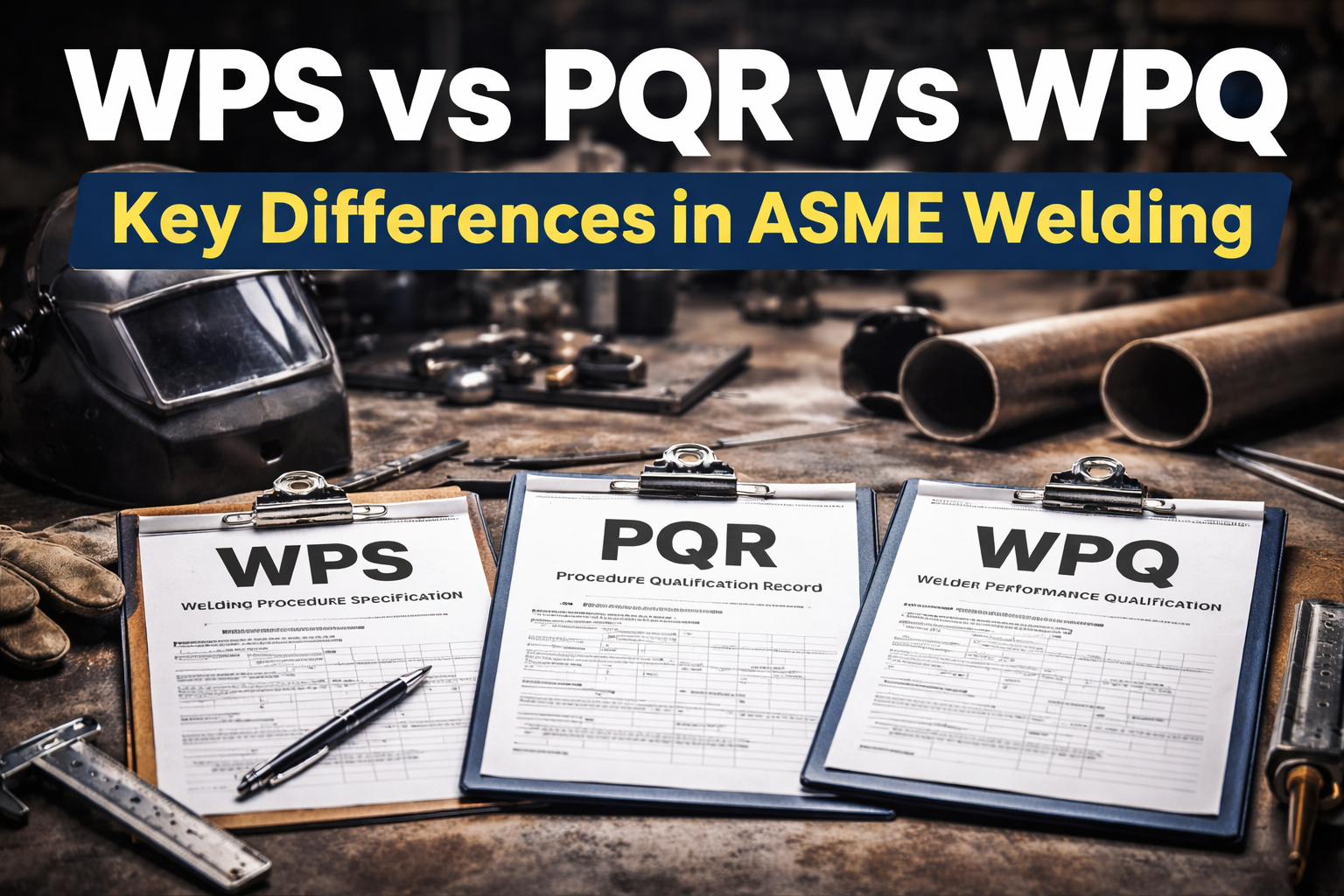
Three key documents are central to this qualification process: Welding Procedure Specification (WPS), Procedure Qualification Record (PQR) and Welder Performance Qualification (WPQ).
Although these terms are closely related, they serve different purposes in the welding quality assurance process. Understanding the difference between WPS vs PQR vs WPQ is essential for welders, inspectors, engineers and fabrication companies working with ASME welding codes.
What is a Welding Procedure Specification (WPS)?
A Welding Procedure Specification (WPS) is a written document that provides detailed instructions on how a weld must be performed.
The WPS defines the welding parameters required to produce a sound weld that meets engineering standards. It ensures that all welders follow the same procedure, resulting in consistent weld quality.
Typical information included in a WPS includes:
-
Welding process (SMAW, MIG, TIG, FCAW, etc.)
-
Base metal specification
-
Filler metal type
-
Welding position
-
Preheat and interpass temperature
-
Voltage and amperage
-
Travel speed
-
Shielding gas requirements
By following a qualified WPS, welders can perform welding operations according to approved procedures that have been tested and verified.
The WPS is essentially a set of instructions for welders to follow during production welding.
What is a Procedure Qualification Record (PQR)?
A Procedure Qualification Record (PQR) is a document that records the actual welding parameters and test results used when qualifying a welding procedure.
Before a WPS can be used in production, it must first be tested and validated. This testing process produces the PQR.
During procedure qualification:
-
A test weld is performed using specific welding parameters.
-
The welded sample is subjected to mechanical testing and inspection.
-
The test results are documented in the PQR.
Common tests performed during procedure qualification include:
-
Tensile testing
-
Bend testing
-
Impact testing
-
Visual inspection
-
Non-destructive testing
If the weld passes all required tests, the procedure is considered qualified and a WPS can be issued based on the PQR results.
In simple terms:
PQR proves that the welding procedure works.
What is Welder Performance Qualification (WPQ)?
The Welder Performance Qualification (WPQ) verifies that an individual welder has the skills required to produce acceptable welds according to a qualified welding procedure.
Even if a welding procedure is qualified, weld quality can still depend on the skill of the welder. Therefore, ASME Section IX requires welders to demonstrate their capability through qualification tests.
During welder qualification:
-
The welder performs a test weld using an approved WPS.
-
The weld is inspected and tested.
-
If the weld meets quality requirements, the welder is considered qualified.
The WPQ ensures that the welder can perform welding operations according to the specified procedure and produce acceptable results.
Key Differences Between WPS, PQR, and WPQ
Although these documents are closely related, they serve different purposes in the welding qualification process.
| Document | Purpose | Function |
|---|---|---|
| WPS | Welding instructions | Define how welding must be performed |
| PQR | Procedure qualification record | Proves the welding procedure works |
| WPQ | Welder performance qualification | Proves the welder can perform the weld |
Understanding this relationship is important because all three documents work together to ensure welding quality and compliance with ASME standards.
How WPS, PQR, and WPQ Work Together
The relationship between WPS, PQR and WPQ can be understood as a step-by-step process.
First, engineers develop a welding procedure and perform a test weld. The results of this test are documented in the PQR.
Once the procedure is successfully tested and approved, a WPS is created to provide instructions for production welding.
Finally, welders must demonstrate their ability to follow the procedure by completing a WPQ test.
The process typically follows this sequence:
PQR → WPS → WPQ
This ensures that:
-
The welding procedure is technically sound
-
Welders can properly follow the procedure
-
Weld quality remains consistent in production
Why WPS, PQR, and WPQ Are Important in Industrial Welding
Welding is often used in applications where structural failure could have serious consequences. Industries such as oil and gas, pressure vessels, power plants and chemical processing facilities rely on strict welding standards to ensure safety.
The qualification system defined by ASME Section IX helps achieve several important objectives.
Ensures Welding Quality
Testing procedures and welder qualifications ensure that welds meet mechanical strength and performance requirements.
Prevents Welding Defects
Proper qualification reduces common welding defects such as cracking, lack of fusion, and incomplete penetration.
Ensures Code Compliance
Following ASME welding qualifications helps organizations meet regulatory and industry standards.
Improves Reliability of Welded Structures
Qualified welding procedures and skilled welders improve the long-term reliability of welded components used in critical infrastructure.
Industries That Use WPS, PQR, and WPQ
These welding qualification documents are widely used across multiple industries.
Common industries include:
-
Oil and gas pipelines
-
Pressure vessel manufacturing
-
Shipbuilding and offshore structures
-
Structural steel fabrication
-
Petrochemical plants
-
Power generation facilities
In these industries, welding procedures and welder qualifications are essential for meeting safety and engineering standards.
Conclusion
Understanding the difference between WPS vs PQR vs WPQ is essential for anyone involved in industrial welding.
- The Procedure Qualification Record (PQR) verifies that a welding procedure produces acceptable results.
- The Welding Procedure Specification (WPS) provides detailed instructions for performing the weld.
- The Welder Performance Qualification (WPQ) confirms that the welder has the necessary skills to perform the procedure correctly.
Together, these documents form the foundation of welding quality assurance under ASME Section IX, ensuring that welding operations are safe, consistent and compliant with industry standards.
For a practical example of how a welding procedure is developed and tested, you can refer to our guide on Welding Procedure Specifications as Per ASME Section IX.
For organizations involved in fabrication, manufacturing and welding training, understanding these qualification requirements is key to maintaining high-quality welding operations and meeting international welding codes.
Keliru Tentang WPS, PQR, WPQ? Panduan Mudah untuk Pengimpal
Dalam industri kimpalan, memastikan kualiti kimpalan yang konsisten adalah sangat penting untuk keselamatan, prestasi, dan pematuhan kepada piawaian.
Industri seperti minyak & gas, pembuatan pressure vessel, pembinaan kapal, dan penjanaan tenaga sangat bergantung kepada standard kimpalan yang ketat bagi memastikan integriti struktur.
Salah satu piawaian paling penting ialah ASME Section IX, yang merupakan sebahagian daripada ASME Boiler and Pressure Vessel Code (BPVC) yang diterbitkan oleh American Society of Mechanical Engineers.
Di bawah piawaian ini, terdapat tiga dokumen utama dalam proses kelayakan kimpalan:
- Welding Procedure Specification (WPS)
- Procedure Qualification Record (PQR)
- Welder Performance Qualification (WPQ)
Walaupun ketiga-tiga istilah ini berkait rapat, setiap satunya mempunyai fungsi yang berbeza. Memahami perbezaan antara WPS, PQR, dan WPQ sangat penting bagi pengimpal, jurutera, pemeriksa, dan syarikat fabrikasi.
Apakah Welding Procedure Specification (WPS)?
Welding Procedure Specification (WPS) ialah dokumen bertulis yang memberikan panduan terperinci tentang bagaimana sesuatu kimpalan perlu dilakukan.
WPS menetapkan parameter kimpalan untuk menghasilkan sambungan yang memenuhi standard kejuruteraan.
Maklumat dalam WPS biasanya termasuk:
- Proses kimpalan (SMAW, MIG, TIG, FCAW)
- Spesifikasi logam asas
- Jenis filler metal
- Kedudukan kimpalan
- Suhu preheat dan interpass
- Voltan dan arus
- Kelajuan pergerakan
- Keperluan gas pelindung
Dengan mengikuti WPS yang telah diluluskan, pengimpal dapat menghasilkan kimpalan yang konsisten dan berkualiti.
Ringkasnya:
WPS = Arahan bagaimana kimpalan perlu dibuat
Apakah Procedure Qualification Record (PQR)?
Procedure Qualification Record (PQR) ialah dokumen yang merekodkan parameter sebenar dan keputusan ujian semasa sesuatu prosedur kimpalan diuji.
Sebelum WPS digunakan, ia mesti diuji terlebih dahulu, dan hasil ujian tersebut direkod dalam PQR.
Proses PQR:
- Ujian kimpalan dilakukan
- Sampel diuji secara mekanikal
- Keputusan direkod
Ujian biasa termasuk:
- Ujian tegangan (tensile test)
- Ujian bengkok (bend test)
- Ujian impak
- Pemeriksaan visual
- Ujian tanpa musnah (NDT)
Jika semua ujian lulus, prosedur tersebut dianggap layak dan WPS boleh digunakan.
Ringkasnya:
PQR = Bukti bahawa prosedur kimpalan berfungsi
Apakah Welder Performance Qualification (WPQ)?
Welder Performance Qualification (WPQ) ialah pengesahan bahawa seorang pengimpal mempunyai kemahiran untuk menghasilkan kimpalan yang memenuhi standard.
Walaupun prosedur sudah diluluskan, kualiti kimpalan masih bergantung kepada kemahiran individu.
Proses WPQ:
- Pengimpal melakukan ujian kimpalan
- Kimpalan diuji dan diperiksa
- Jika lulus, pengimpal dianggap layak
Ringkasnya:
WPQ = Bukti pengimpal boleh buat kimpalan dengan betul
Perbezaan Utama WPS, PQR, dan WPQ
| Dokumen | Tujuan | Fungsi |
|---|---|---|
| WPS | Arahan kimpalan | Menentukan cara kimpalan dilakukan |
| PQR | Rekod kelayakan prosedur | Membuktikan prosedur berfungsi |
| WPQ | Kelayakan pengimpal | Membuktikan kemahiran pengimpal |
Bagaimana WPS, PQR dan WPQ Bekerja Bersama
Ketiga-tiga dokumen ini saling berkaitan dalam satu proses:
- Prosedur diuji → PQR
- Arahan disediakan → WPS
- Pengimpal diuji → WPQ
Urutan:
PQR → WPS → WPQ
Ini memastikan:
- Prosedur kimpalan betul
- Pengimpal ikut prosedur
- Kualiti kimpalan konsisten
Kenapa WPS, PQR dan WPQ Penting?
Menjamin Kualiti Kimpalan
Prosedur dan pengimpal diuji untuk memastikan kekuatan kimpalan.
Mencegah Kecacatan
Mengurangkan masalah seperti retakan, lack of fusion, dan penetration tidak mencukupi.
Mematuhi Piawaian
Memastikan pematuhan kepada ASME dan standard industri.
Meningkatkan Kebolehpercayaan Struktur
Kimpalan lebih tahan lama dan selamat digunakan.
Industri Yang Menggunakan WPS, PQR, WPQ
- Minyak dan gas
- Pressure vessel
- Pembinaan kapal
- Fabrikasi struktur
- Petrokimia
- Loji tenaga
Dalam industri ini, kawalan kimpalan sangat kritikal.
Kesimpulan
Memahami perbezaan antara WPS, PQR, dan WPQ adalah sangat penting dalam industri kimpalan.
- PQR memastikan prosedur berfungsi
- WPS memberi panduan kimpalan
- WPQ memastikan pengimpal kompeten
Ketiga-tiganya membentuk asas kepada sistem kawalan kualiti kimpalan di bawah ASME Section IX.
Bagi syarikat fabrikasi, latihan, dan pembuatan, pemahaman ini membantu memastikan operasi kimpalan yang selamat, konsisten, dan mematuhi piawaian antarabangsa.
No. Tel: 05-3665621 / 019-3132353
Email: info@weldmart.com.my
Address: No. 3 & 3A, Persiaran Batu Gajah Perdana 7,
Pusat Komersial Batu Gajah Perdana,
31550 Pusing, Perak