
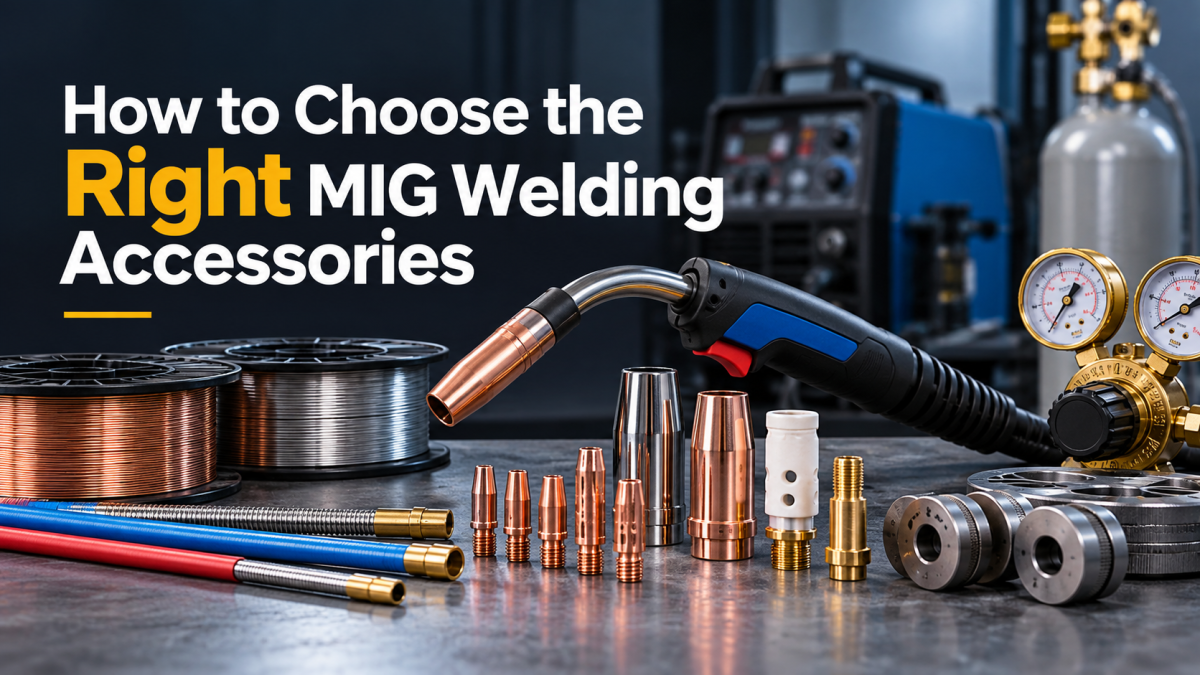
MIG welding is one of the most widely used welding processes in fabrication, manufacturing, automotive, maintenance and general workshop applications. While selecting the right MIG welding machine is important, the correct accessories are equally essential for achieving stable arc performance, consistent weld quality and longer equipment life.
Using the wrong torch, contact tip, liner, nozzle or regulator can result in problems such as poor wire feeding, unstable arcs, excessive spatter, overheating and inconsistent weld penetration.
With so many MIG welding accessories available, how do you know which ones are suitable for your application?
1. Choose Correct MIG Torch
The MIG torch is one of the most important accessories because it delivers the welding current, shielding gas and welding wire to the workpiece.
When selecting a MIG torch, consider:
- Rated welding current
- Duty cycle
- Torch length
- Air-cooled or water-cooled design
- Torch connection type
- Type of welding application
For general fabrication and workshop applications, an air-cooled MIG torch is commonly used. For high-current and heavy-duty welding where the torch is exposed to prolonged welding, a water-cooled torch may be more suitable.
Why torch rating matters
For example, using a torch that is rated for a lower current than your welding application can cause excessive heating and premature wear. Always check the torch’s amperage and duty-cycle rating against your welding machine and application.
2. Select Correct Contact Tip
The contact tip transfers welding current to the MIG wire as it passes through the torch. It is a small component, but it has a major effect on welding performance.
Contact tips are available in different:
- Wire sizes
- Materials
- Thread types
- Lengths
- Designs
The contact tip should match the diameter and type of welding wire being used.
Signs of a worn contact tip
A contact tip may need to be replaced when you notice:
- Unstable arc
- Inconsistent wire feeding
- Burn-back
- Excessive tip wear
- Wire sticking inside the tip
- Poor electrical contact
Keeping spare contact tips in different sizes is a good practice for any MIG welding workshop.
3. Choose Right MIG Torch Liner
The MIG liner guides the welding wire from the wire feeder through the torch cable assembly to the contact tip. The correct liner depends on the type and diameter of welding wire.
Common liner materials include:
1. Steel Liner
Steel liners are commonly used for:
- Mild steel wire
- Stainless steel wire
- General MIG/MAG welding
They provide good durability and are suitable for many workshop applications.
2. PTFE or Teflon Liner
PTFE liners are commonly used for softer wires such as:
- Aluminium
- Certain aluminium alloys
- Other soft welding wires
Soft wire can experience feeding problems when used with an unsuitable liner. A suitable low-friction liner can help improve wire feeding.
Important consideration
The liner should match:
Wire diameter + wire material + torch specification
Using the wrong liner can lead to wire feeding resistance, bird-nesting and inconsistent welding.
4. Select Correct MIG Nozzle
The gas nozzle directs shielding gas around the welding arc and molten weld pool.
Nozzles are available in different:
- Diameters
- Lengths
- Shapes
- Thread or mounting designs
Small vs large nozzle
A smaller nozzle can provide better access when welding in restricted areas. A larger nozzle can provide a wider shielding-gas coverage and may be useful for certain applications.
The nozzle should also provide enough clearance around the contact tip while maintaining the manufacturer’s recommended contact-tip-to-work distance. A damaged or heavily spattered nozzle can restrict gas flow and affect shielding.
5. Don’t Forget Gas Diffuser
The gas diffuser connects the torch components and helps distribute shielding gas through the nozzle.
It is important to make sure the diffuser is compatible with:
- MIG torch model
- Contact tip
- Nozzle
- Welding wire/application
If the diffuser is damaged or blocked by excessive spatter, shielding gas flow can be affected.
This may result in:
- Porosity
- Excessive oxidation
- Unstable arc
- Poor weld appearance
6. Choose Correct Shielding Gas Regulator
The regulator controls the shielding-gas pressure and flow supplied to the welding torch.
Different shielding gases may be used depending on the welding process and material, including:
- CO₂
- Argon
- Argon/CO₂ mixtures
- Argon/helium mixtures
The regulator must be suitable for the gas type and cylinder connection being used.
For MIG/MAG welding, it is also important to distinguish between:
- Pressure regulator – primarily reduces cylinder pressure.
- Flowmeter/regulator – allows the operator to monitor and control gas flow.
Correct gas flow is essential because both insufficient and excessive shielding gas can cause problems.
Too little gas
Can cause:
- Porosity
- Oxidation
- Contamination
- Poor weld appearance
Too much gas
Can create turbulence around the arc and potentially draw atmospheric air into the shielding area. Therefore, don’t simply increase gas flow to solve welding problems. Check the torch, nozzle, gas hose and regulator first.
7. Select Correct Welding Wire
Although welding wire is technically a consumable rather than an accessory, it is one of the most important parts of the MIG welding setup.
The wire should be selected according to:
- Base material
- Material thickness
- Welding position
- Welding current
- Shielding gas
- Required weld properties
Common MIG wire sizes include:
0.8 mm, 0.9 mm, 1.0 mm, 1.2 mm and 1.6 mm.
For example, a smaller diameter wire is often suitable for thinner materials and lower-current applications, while larger wire diameters can be used for higher deposition rates and heavier fabrication.
Always refer to the welding wire manufacturer’s recommendations for the appropriate current range and shielding gas.
8. Check Drive Roll
The drive roll is responsible for pushing welding wire from the spool into the MIG torch. It must be compatible with the wire being used.
Different drive-roll profiles are available for different wire types.
For example:
- V-groove – commonly used for solid steel wire
- U-groove – commonly used for softer wires such as aluminium
- Knurled V-groove – commonly used for certain flux-cored wires
Using the wrong drive roll can cause:
- Wire slipping
- Wire deformation
- Poor feeding
- Bird-nesting
- Excessive wear
The drive-roll pressure should also be adjusted correctly. Too much pressure can deform the wire, while too little pressure can cause slipping.
9. Select Correct Welding Cable and Earth Clamp
A complete MIG welding setup also requires proper work-return connections.
The welding cable and earth clamp should be selected based on:
- Welding current
- Duty cycle
- Cable length
- Application
- Connection type
For higher-current applications, an appropriately sized welding cable is required to reduce voltage drop and excessive cable heating. The earth clamp should also provide a secure electrical connection to the workpiece.
A poor work connection can cause:
- Unstable arc
- Excessive spatter
- Difficulty starting the arc
- Inconsistent welding performance
Before welding, make sure the workpiece is clean and the earth connection is secure.
How to Make Sure Your MIG Setup Works Together
The best way to select MIG accessories is to look at the entire welding system, rather than choosing each component separately.
A typical setup consists of:
MIG Welding Machine → Wire Feeder → Drive Roll → Welding Wire → Torch Liner → Contact Tip → Nozzle → Workpiece
At the same time:
Gas Cylinder → Regulator/Flowmeter → Gas Hose → MIG Torch → Shielding Gas
Every component needs to work together.
For example, changing from 0.8 mm mild steel wire to 1.2 mm aluminium wire may require changes to the drive roll, liner, contact tip and welding parameters.
Conclusion
Choosing the correct MIG welding accessories is just as important as selecting the right welding machine. The correct combination of MIG torch, contact tip, liner, nozzle, gas regulator, drive roll, welding wire and welding cables can improve wire feeding, arc stability, shielding-gas performance and overall weld quality.
For workshops and industrial users, keeping the correct replacement consumables available can also reduce downtime and maintain consistent welding production.
Need help selecting the right MIG welding accessories?
Contact Weldmart with your welding machine model, welding wire diameter, wire material and application. Our team can help you identify the appropriate accessories and consumables for your MIG welding setup.
Tel: +605-3665621 / +6019-3132353
Email: info@weldmart.com.my
Address: No. 3 & 3A, Persiaran Batu Gajah Perdana 7,
Pusat Komersial Batu Gajah Perdana,
31550 Pusing, Perak