
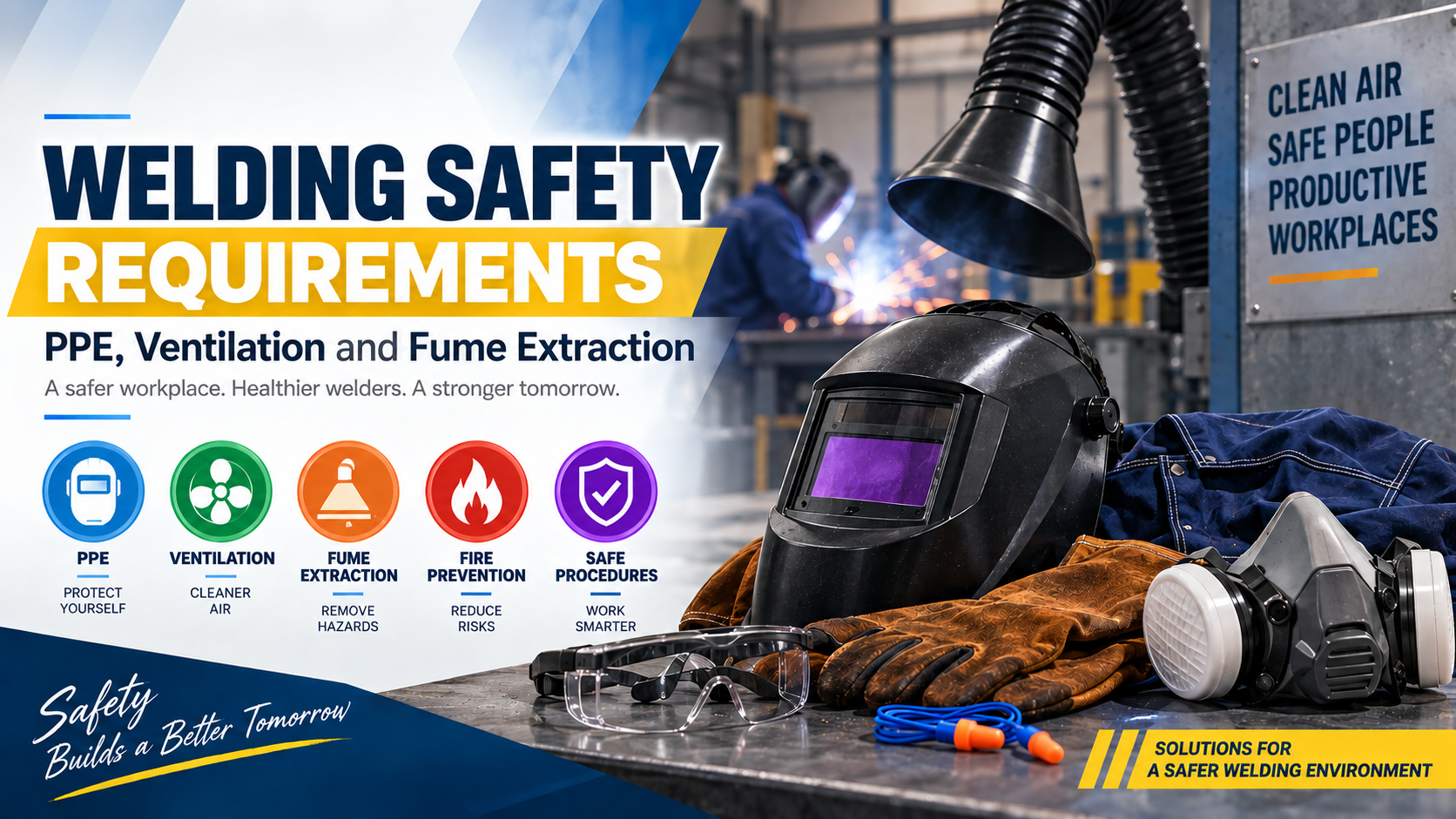
Welding is an essential process in fabrication, manufacturing, construction and technical training. However, welding can also expose workers and students to hazards such as welding fumes, UV radiation, sparks, heat, fire, electric shock and flying particles.
A safe welding environment requires more than simply wearing a welding helmet. Proper Personal Protective Equipment (PPE), ventilation, welding fume extraction, fire prevention and safe working procedures are all important parts of a welding safety programme.
Why is Welding Safety Important?
Welding produces intense heat, light, sparks and airborne contaminants. Welding fume can contain particles and gases generated from the welding process, base metal and consumables.
Exposure to uncontrolled welding fume can contribute to serious occupational health problems. According to the UK Health and Safety Executive (HSE), states that welding fume can cause lung disease, with risks including asthma and cancer. The level of exposure depends on factors such as the welding process, material, consumable and working environment.
For this reason, welding safety should be considered before welding begins rather than relying only on PPE after exposure has already occurred.
Essential Welding PPE
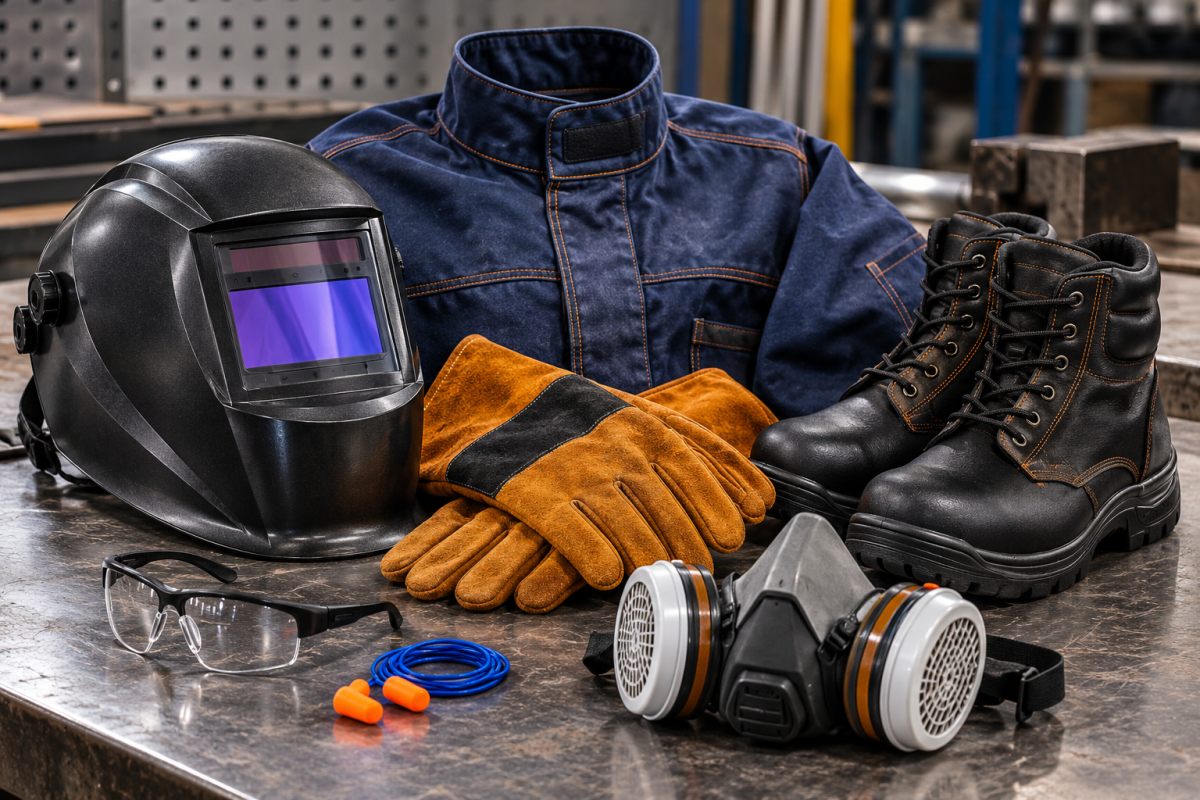
Personal Protective Equipment is an important part of welding safety. The exact PPE required depends on the welding process, materials, task and risk assessment.
1. Welding Helmet
A suitable welding helmet protects the welder’s eyes and face from:
- Arc radiation
- UV and infrared radiation
- Sparks
- Spatter
- Heat
- Flying particles
The correct welding filter/shade should be selected according to the welding process and operating conditions.
2. Welding Gloves
Welding gloves protect the hands from:
- Heat
- Sparks
- Molten metal
- Sharp edges
- Abrasion
Gloves should provide suitable protection while still allowing the operator to control the welding torch, electrode holder or workpiece safely.
3. Flame-Resistant Clothing
Welders should wear suitable clothing that covers exposed skin.
Recommended welding clothing includes:
- Flame-resistant jacket
- Long-sleeve clothing
- Welding apron where appropriate
- Long trousers
- Suitable welding boots
Avoid clothing made from materials that can easily melt or ignite.
4. Safety Footwear
Safety footwear helps protect against:
- Hot metal
- Falling objects
- Sparks
- Sharp materials
- Slips and workshop hazards
Welding Ventilation: Why is It Important?
Good ventilation helps remove contaminated air and reduce the concentration of welding fumes in the workplace.
There are two common approaches:
General Ventilation
General or mechanical ventilation moves contaminated air away from the welding area and introduces or circulates cleaner air. However, general ventilation alone may not be sufficient for controlling welding fume close to the welder’s breathing zone.
For indoor welding, HSE recommends effective engineering controls, with LEV used to capture welding fume at source where possible.
Local Exhaust Ventilation (LEV)
Local Exhaust Ventilation (LEV) captures welding fumes close to where they are generated before they spread into the worker’s breathing zone or the wider workshop.
Examples include:
- Movable extraction arms
- Welding fume extraction hoods
- Extracted welding benches
- Extracted welding booths
- On-torch extraction systems
The extraction hood should be positioned correctly so that the fume is captured effectively at the source.
What is Welding Fume Extraction?
A welding fume extraction system is designed to capture and remove airborne contaminants generated during welding. Instead of allowing fumes to spread throughout the workshop, the system draws contaminated air towards an extraction point.
A typical welding fume extraction system may include:
Welding Area → Extraction Hood → Filter → Clean Air / Safe Discharge
The exact system design depends on factors such as:
- Number of welding stations
- Welding process
- Welding frequency
- Materials being welded
- Workshop size
- Workpiece dimensions
- Indoor or outdoor operation
- Required level of fume control
For this reason, selecting a welding fume extractor should be based on the actual workshop application rather than simply choosing the largest available unit.
Welding Curtains and Screens
Welding curtains and screens are another important part of workshop safety. They help protect nearby workers and students from direct and reflected arc radiation. Welding screens can also help separate individual welding bays and create a safer training environment.
However, a welding curtain is not a substitute for welding fume extraction. Its primary purpose is to provide protection from welding arc radiation and sparks, while extraction systems address airborne contaminants.
HSE recommends suitable welding curtains/screens that provide appropriate protection from welding arc light.
Welding Safety for TVET Training Centres
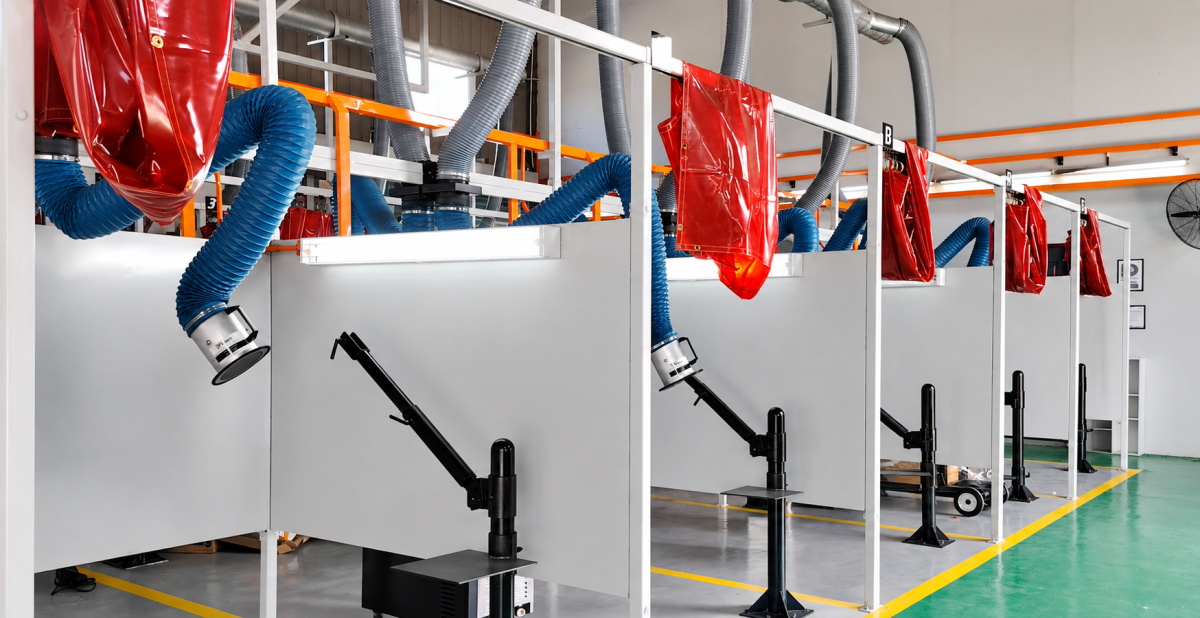
Welding safety is especially important in TVET institutions, vocational colleges and welding training centres, where multiple students may be welding simultaneously.
A properly designed welding workshop should consider:
- Individual welding booths
- Welding machines
- Welding PPE
- Welding curtains
- Fume extraction
- General workshop ventilation
- Safe electrical installation
- Fire prevention
- Emergency equipment
- Student safety procedures
- Instructor supervision
Fume extraction should be designed around the number and arrangement of welding stations rather than treated as an optional workshop accessory.
Workers and students should also be trained to position extraction equipment correctly and understand how to check whether the controls are working effectively. HSE specifically highlights training on LEV positioning, pre-use checks and keeping fumes out of the breathing zone.
Building a Safer Welding Workshop
A safe welding workshop requires a combination of equipment, engineering controls, PPE, training and good working practices.
For a professional workshop or TVET training centre, the basic safety system should include:
Welding Machine + PPE + Welding Booth + Welding Curtain + Fume Extraction + Ventilation + Safety Procedures + Training
No single piece of equipment can eliminate every welding hazard.
The objective is to control hazards at the source, protect the welder and prevent exposure to other people in the workshop.
Welding Safety Solutions for Workshops and TVET Institutions
Weldmart provides welding equipment and workshop solutions for industries, fabrication workshops, universities, TVET institutions and technical training centres in Malaysia.
If you are planning to set up a new welding workshop, upgrade an existing facility or establish a welding training centre, Weldmart can help you select suitable welding equipment and fume control solutions based on your workshop requirements.
Contact Weldmart for welding equipment, fume extraction and workshop safety solutions.
Tel: +605-3665621 / +6019-3132353
Email: info@weldmart.com.my
Address: No. 3 & 3A, Persiaran Batu Gajah Perdana 7,
Pusat Komersial Batu Gajah Perdana,
31550 Pusing, Perak