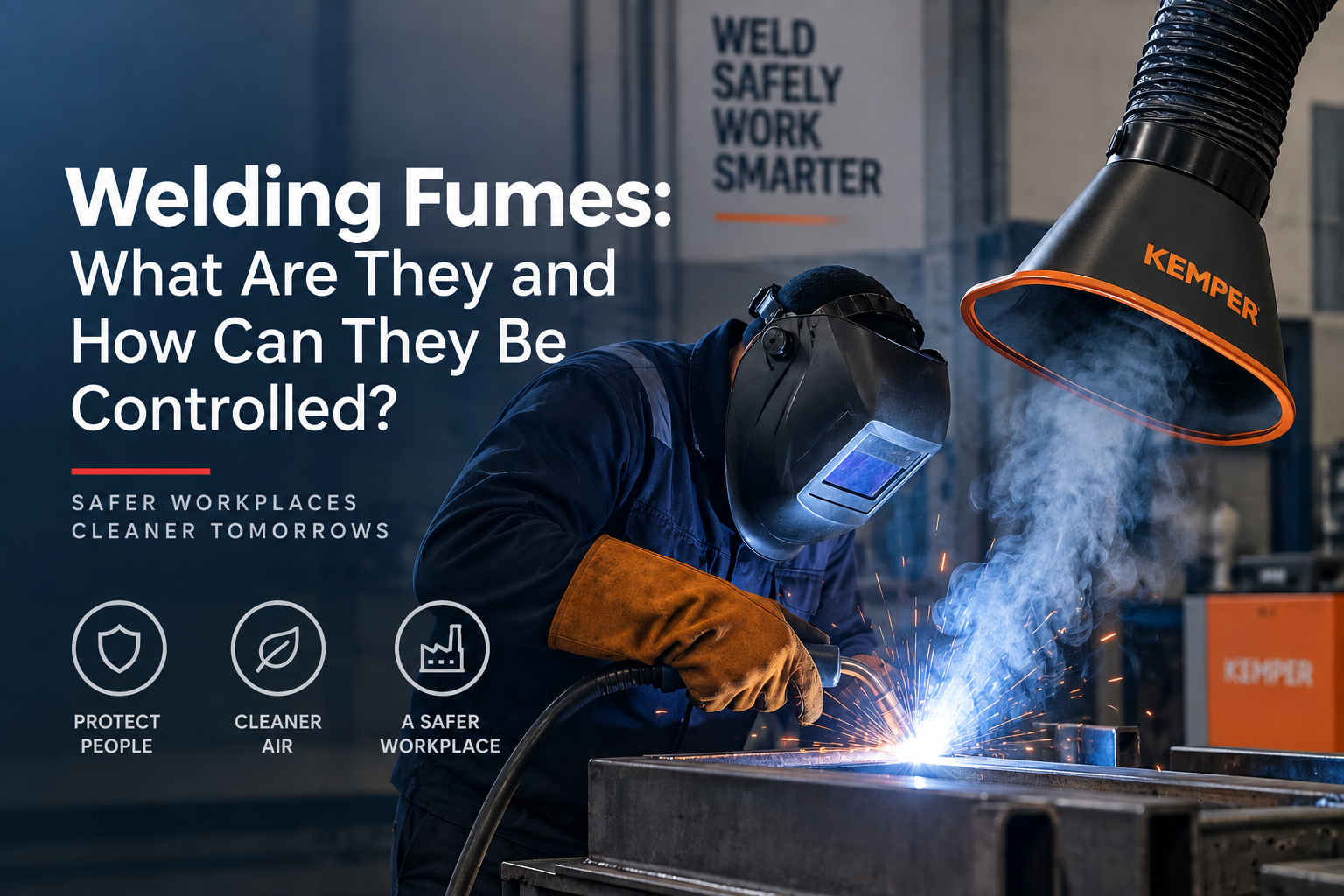
Welding is widely used in metal fabrication, manufacturing, construction, automotive, maintenance, and technical training. While welding is an essential industrial process, it also produces welding fumes, gases, vapours, and airborne particles that need to be properly controlled.
For workshops and welding training centres, understanding where welding fumes come from and how to control them is an important part of creating a safer and cleaner working environment.
One of the most effective approaches is to capture welding fumes as close as possible to the source using a welding fume extraction system.
What Are Welding Fumes?
Welding fumes are produced when metal, filler material, coatings, and other substances are heated during welding.
The characteristics and amount of welding fumes can vary depending on several factors, including:
- Welding process
- Type of base material
- Filler material
- Welding parameters
- Surface coatings
- Welding duration
- Workshop ventilation
- Number of welding stations
Different welding processes can therefore produce different levels of airborne contaminants.
Why Should Welding Fumes be Controlled?
When welding fumes are released into a workshop, they can disperse away from the welding point and affect the surrounding working environment. This can become a greater challenge in enclosed workshops, production areas, and training centres where several welding stations operate at the same time.
A good welding fume control strategy aims to prevent fumes from spreading unnecessarily throughout the workspace. Rather than relying only on general ventilation, local exhaust ventilation (LEV) can be used to capture welding fumes directly at the source.
What is Local Exhaust Ventilation?
Local exhaust ventilation is a method of removing contaminated air close to the point where it is generated. For welding applications, this is commonly achieved using an extraction arm and hood positioned near the welding area.
The extraction hood captures the welding plume and directs it through the extraction arm to a filtration or extraction unit.
The principle is simple:
Welding Process → Fume Capture → Filtration → Cleaned Air
The closer and more appropriately positioned the extraction hood is to the welding source, the more effectively the system can capture the generated fumes.
Weldmart also provides fume extractor arm solutions designed for source capture applications. Its extractor arm offering includes flexible positioning and adjustable extraction hoods for welding and other industrial processes.
Main Type of Welding Fume Control
There is no single extraction system that is suitable for every workshop. The appropriate solution depends on the size of the facility, welding frequency, number of welding stations, and the amount of smoke and dust generated.
1. Mobile Welding Fume Extractor
Mobile extraction units are designed to be moved between different workstations.
They are particularly useful when:
- Welding locations change
- The workshop requires flexibility
- Permanent ductwork is not practical
- Individual welding stations require source extraction
- The same extraction system needs to serve different areas
KEMPER mobile units such as the SmartMaster, SmartFil, and ProfiMaster are examples of systems designed for different levels of welding activity.
The SmartMaster is intended for occasional use and low amounts of smoke and dust, while SmartFil is designed for frequent use and medium levels of smoke and dust. The ProfiMaster is designed for occasional to frequent use with low to medium levels of smoke and dust.
2. Stationary Welding Fume Extraction
For fixed welding workstations, a stationary extraction system can provide a more permanent solution. This type of system is particularly useful where welding activities take place regularly at dedicated positions.
The KEMPER MaxiFil Stationary, for example, is designed for regular welding applications and can be configured with different extraction arm lengths. It is suitable for all materials, including high-alloy steel, and is designed for medium levels of smoke and dust.
3. Extraction Arms
An extraction arm is the connection between the welding source and the extraction system. Its main purpose is to position the extraction hood close to the welding plume. Extraction arms can be supplied in different lengths and configurations depending on the workstation.
What About Large Welding Workshops?
Large workshops may have many welding stations and welding activities that change throughout the day. In these environments, individual extraction arms may not always be sufficient as the only method of air management.
A combination of local extraction and general ventilation may provide a more comprehensive solution.
KEMPER’s AirDome is designed for general ventilation applications, particularly where local exhaust ventilation is not possible or where general ventilation is required to complement local extraction. It uses the displacement flow principle and provides an extraction capacity of 8,000–20,000 m³/h.
Local Extraction vs General Ventilation
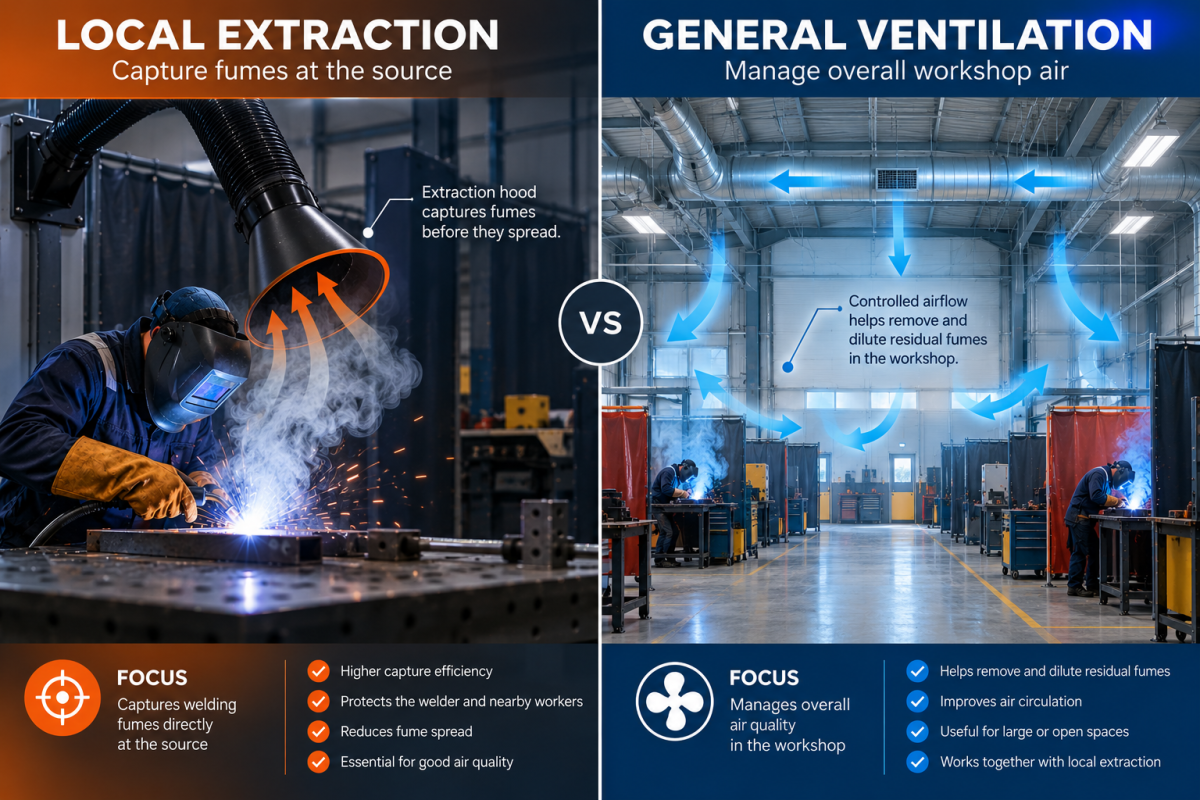
It is important to understand that local extraction and general ventilation serve different purposes. Local extraction focuses on capturing welding fumes close to the source. General ventilation manages air movement and air quality throughout a larger workspace.
For a workshop with fixed welding booths, local extraction may be the primary solution. For a large facility with changing welding locations, general ventilation may play a more important role. In some facilities, both approaches can be used together.
Why is Extraction Hood Position Important?
Installing an extraction system alone does not guarantee effective fume capture. The extraction hood should be positioned appropriately in relation to the welding source.
If the hood is too far away, welding fumes can disperse before reaching the extraction zone. Operators should therefore understand how to position and adjust the extraction arm during welding. Modern extraction systems can make this easier through flexible arms and optimized extraction hood designs.
For example, KEMPER’s ProfiMaster, SmartFil, and MaxiFil Stationary systems use flow-optimized extraction hood designs that reduce the need for frequent adjustment.
Welding Fume Extraction for TVET and Training Centres
Welding training centres often have several welding booths operating at the same time. Students may also use different welding processes and materials during practical training.
For this reason, fume extraction should be considered as part of the overall welding bay design rather than as an afterthought.
Depending on the number of booths and workshop layout, a training centre may consider:
- Individual extraction arms
- Mobile fume extractors
- Stationary extraction systems
- Multiple extraction arms
- General ventilation
- A combination of local and general extraction
Weldmart’s welding bay solutions are designed to accommodate elements such as ducting systems, manifold systems, fume arms, and welding tables, allowing the extraction solution to be considered together with the overall workshop layout.
KEMPER Welding Fume Extraction Solutions from Weldmart
For workshops looking for professional welding fume extraction, Weldmart can provide solutions covering different application requirements.
The KEMPER range includes compact mobile systems such as SmartMaster, higher-capacity mobile systems such as SmartFil and ProfiMaster, stationary extraction such as MaxiFil Stationary, dedicated extraction arms, and larger general ventilation solutions such as AirDome.
The right solution depends on the actual welding application, workshop layout, number of welding stations, frequency of welding, and required extraction capacity.
Conclusion
Welding fumes are a natural by-product of welding, but they should not simply be allowed to spread throughout the workshop.
An effective approach starts with capturing fumes at the source, followed by appropriate filtration and, where required, general workshop ventilation. From mobile fume extractors and extraction arms to stationary systems and large-scale ventilation solutions, different technologies are available for different welding environments.
For workshops, manufacturers, fabrication companies, and TVET institutions in Malaysia, Weldmart can help assess the application and recommend a suitable welding fume extraction solution.
Looking for the right welding fume extraction system for your workshop? Contact Weldmart for product recommendations and quotation.
Tel: +605-3665621 / +6019-3132353
Email: info@weldmart.com.my
Address: No. 3 & 3A, Persiaran batu Gajah Perdana 7,
Pusat Komersial Batu Gajah Perdana,
31550 Pusing, Perak.