
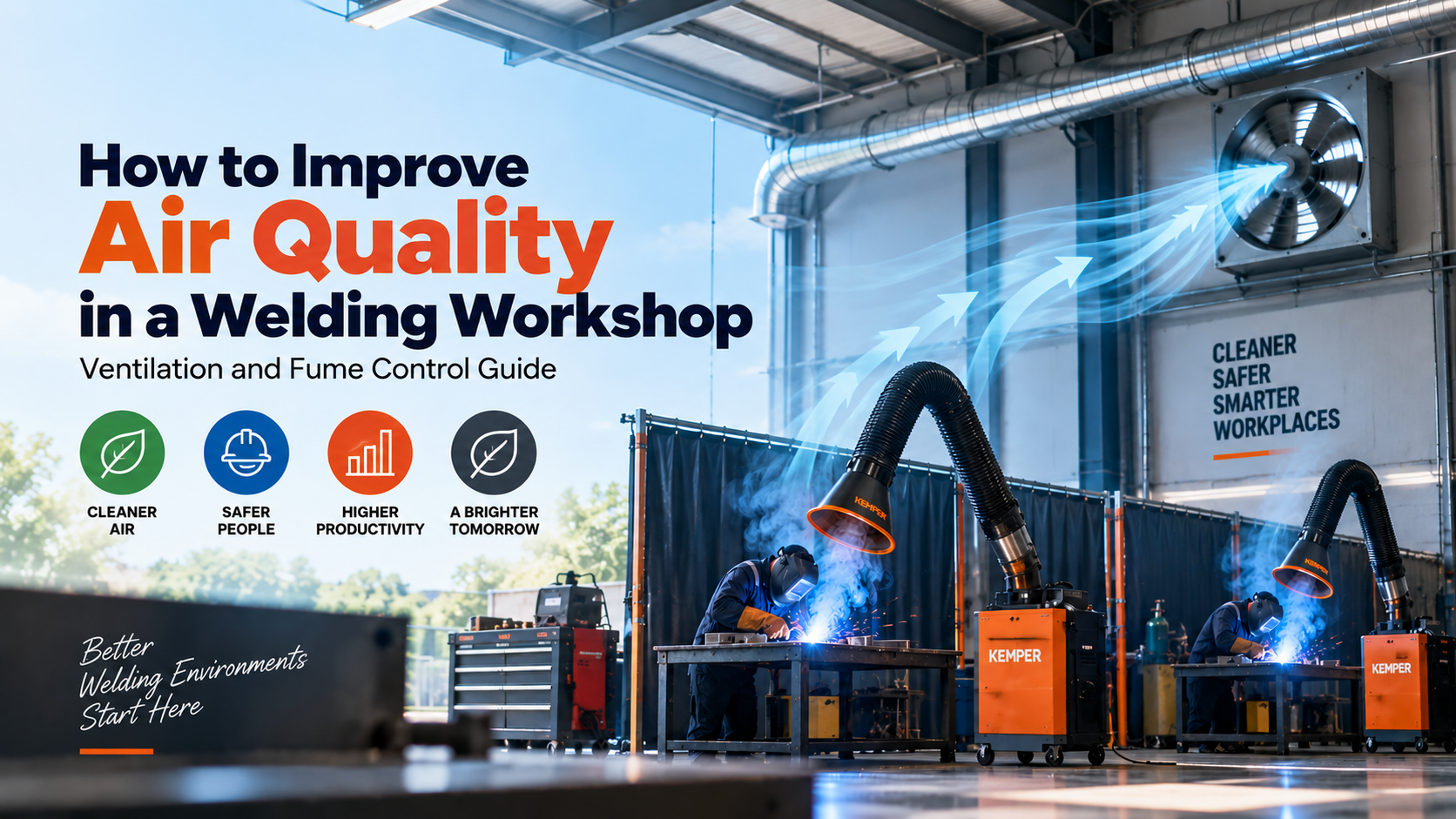
A welding workshop can generate significant amounts of smoke, fumes, gases, and airborne particles, particularly when several welding stations operate at the same time.
Good workshop air quality is therefore not achieved simply by opening doors or installing fans. A properly planned welding ventilation and fume extraction system should consider where contaminants are generated, how they move through the workshop, and how they can be captured and removed effectively.
This guide explains the main approaches that welding workshops can consider to improve air quality and create a cleaner working environment.
Why Air Quality Matters in Welding Workshops
Welding produces airborne contaminants as part of the welding process. When these contaminants are not effectively controlled, they can spread throughout the workshop.
This becomes more challenging in enclosed spaces or facilities where multiple welding stations operate simultaneously.
Poorly managed airflow can cause welding fumes to move from one workstation to another, affecting the wider workshop environment.
A good air quality strategy should therefore focus on controlling fumes at the source first, followed by appropriate ventilation of the overall workspace.
1. Capture Welding Fumes at the Source
The most direct approach to controlling welding fumes is to capture them as close as possible to where they are generated.
Extraction arms and hoods are commonly used for this purpose. A properly positioned extraction hood draws welding fumes away from the welding area before they can disperse into the surrounding air.
This is generally more effective than relying only on general workshop fans to move contaminated air around the building.
2. Use the Right Type of Extraction System
Different workshops require different types of extraction equipment.
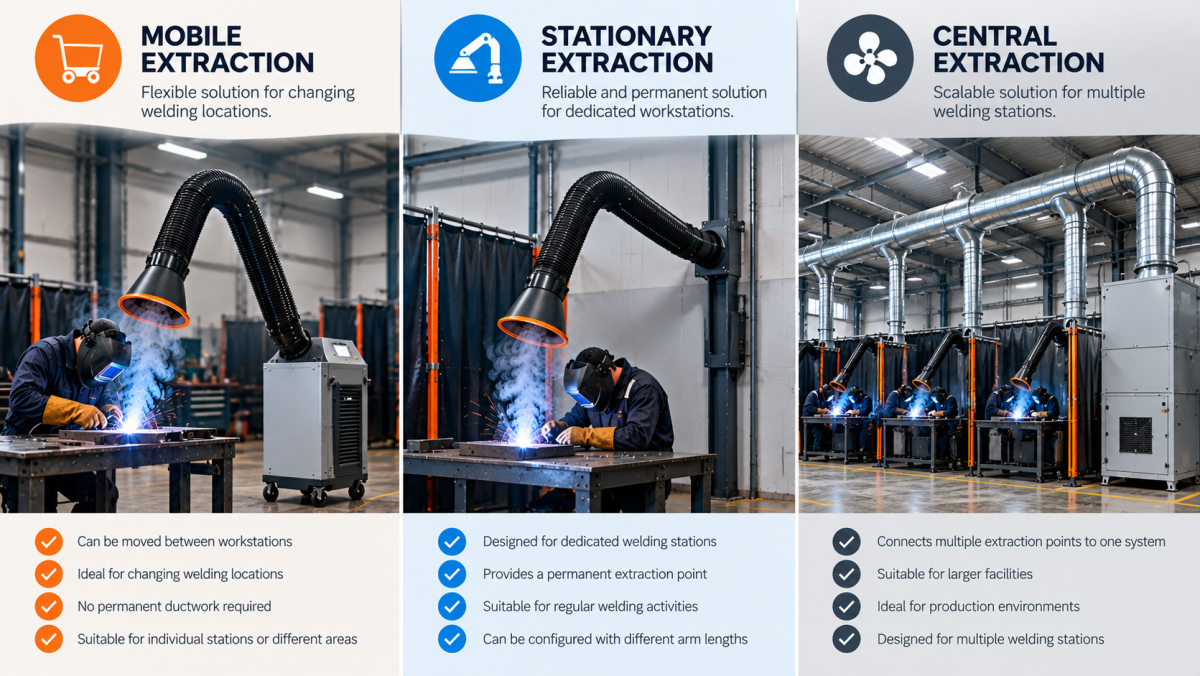
- Mobile Extraction
Mobile extraction units are useful for workshops where welding activities change location. The unit can be moved between workstations and positioned close to the welding operation. This provides flexibility without requiring a permanent ductwork installation at every workstation. - Stationary Extraction
Stationary extraction systems are suitable for dedicated welding booths or fixed workstations. They provide a permanent extraction point and can be integrated into the workshop layout. - Central Extraction
For larger facilities with multiple welding stations, a central extraction system can connect several extraction points to one filtration system. This approach may be suitable for production environments where welding activities are concentrated in fixed locations.
3. Consider General Ventilation
Source extraction should be supported by appropriate general ventilation where required. General ventilation helps manage the overall air within a workshop and can complement local extraction systems.
This can be particularly useful in large facilities where welding activities take place at multiple locations. Some modern ventilation systems use controlled airflow patterns to help move contaminated air toward the filtration or extraction point.
4. Avoid Simply Blowing Welding Fumes Around
One common mistake in welding workshops is using fans without considering airflow direction. A fan may reduce the feeling of heat or smoke around one workstation while unintentionally pushing welding fumes toward another worker. Air movement should therefore be planned rather than simply increased.
The objective should be to move contaminated air toward an appropriate extraction or filtration point rather than distributing it throughout the workshop.
5. Position Extraction Hoods Correctly
The position of the extraction hood has a major impact on source capture. An extraction hood that is positioned too far away from the welding point may capture significantly less of the generated fumes.
Operators should be trained to keep the hood as close as practical to the welding area while maintaining safe and unobstructed working conditions. Flexible extraction arms can make this easier because the operator can reposition the hood as the welding activity changes.
6. Select the Correct Filter System
Filtration is another important component of a welding fume extraction system. Different systems may use different filter technologies, filter surfaces, and filtration stages.
When selecting a filter system, consider:
- Type of welding process
- Welding material
- Amount of welding fumes
- Frequency of welding
- Required extraction capacity
- Filter efficiency
- Maintenance requirements
A suitable filtration system should be selected according to the actual application rather than simply choosing the largest available unit.
7. Maintain Filters Regularly
A welding fume extraction system requires proper maintenance to continue operating effectively. Filters can accumulate dust and particles over time. If filters are not maintained or replaced when required, airflow and extraction performance may be affected.
Regular maintenance should include checking:
- Filter condition
- Pre-filters
- Extraction hoses
- Extraction hoods
- Ducting, where applicable
- Fan operation
- Filter monitoring indicators
Following the manufacturer’s maintenance recommendations can help maintain consistent system performance.
8. Consider the Number of Welding Stations
The number of welding stations has a direct impact on workshop ventilation requirements. A small workshop with one or two welding stations may require a relatively simple extraction solution.
A larger training centre or production facility with many welding booths may require multiple extraction arms, stationary systems, central extraction, or a combination of local and general ventilation. Planning the system based on the actual number of welding stations can also make future expansion easier.
9. Improve Workshop Layout
Workshop layout can influence how effectively welding fumes are controlled. Where possible, welding areas should be organized so that extraction equipment can be positioned efficiently.
Consider:
- Distance between welding stations
- Location of extraction equipment
- Airflow direction
- Worker movement
- Material handling routes
- Access for maintenance
- Future expansion
A well-planned layout can make extraction equipment easier to operate and maintain.
10. Train Operators
Even a well-designed extraction system depends on correct operator usage.
Welders should understand:
- Why extraction is required
- Where the extraction hood should be positioned
- How to adjust the extraction arm
- How to identify filter problems
- When maintenance should be reported
- How workshop airflow can affect fume capture
Operator training should therefore be included as part of the overall welding fume control strategy.
KEMPER Welding Fume Extraction Solutions
For workshops requiring professional welding fume control, KEMPER provides a range of solutions covering different applications. These include mobile extraction units, extraction arms, stationary extraction systems, and general ventilation solutions.
The appropriate system depends on the workshop environment rather than simply the equipment model. For example, a small workshop with occasional welding may require a different solution from a large manufacturing facility with multiple welding stations operating continuously.
Welding Workshop Air Quality: A Complete Approach
Improving air quality should not depend on one piece of equipment.
A more effective strategy combines:
Source Capture + Filtration + General Ventilation + Maintenance + Operator Training
- Source extraction captures fumes where they are produced.
- Filtration removes airborne particles from the extracted air.
- General ventilation helps manage the overall workshop environment.
- Regular maintenance keeps the equipment operating effectively.
- Operator training ensures the system is used correctly.
Together, these elements provide a more comprehensive approach to welding fume management.
Conclusion
Improving air quality in a welding workshop requires more than simply installing fans or opening doors. The most effective approach begins with understanding where welding fumes are generated and controlling them as close to the source as possible. This can then be supported by appropriate filtration and general workshop ventilation.
Whether you operate a small fabrication workshop, manufacturing facility, welding school, or TVET training centre, the right welding fume extraction and ventilation system should be selected based on the actual working environment.
Weldmart provides professional welding fume extraction solutions, including KEMPER extraction systems, to support workshops and training institutions in developing cleaner and better-controlled welding environments.
Tel: 05-3665621 / 019-3132353
Email: info@weldmart.com.my
Address: No. 3 & 3A, Persiaran Batu Gajah Perdana 7,
Pusat Komersial Batu Gajah Perdana,
31550 Pusing, Perak