
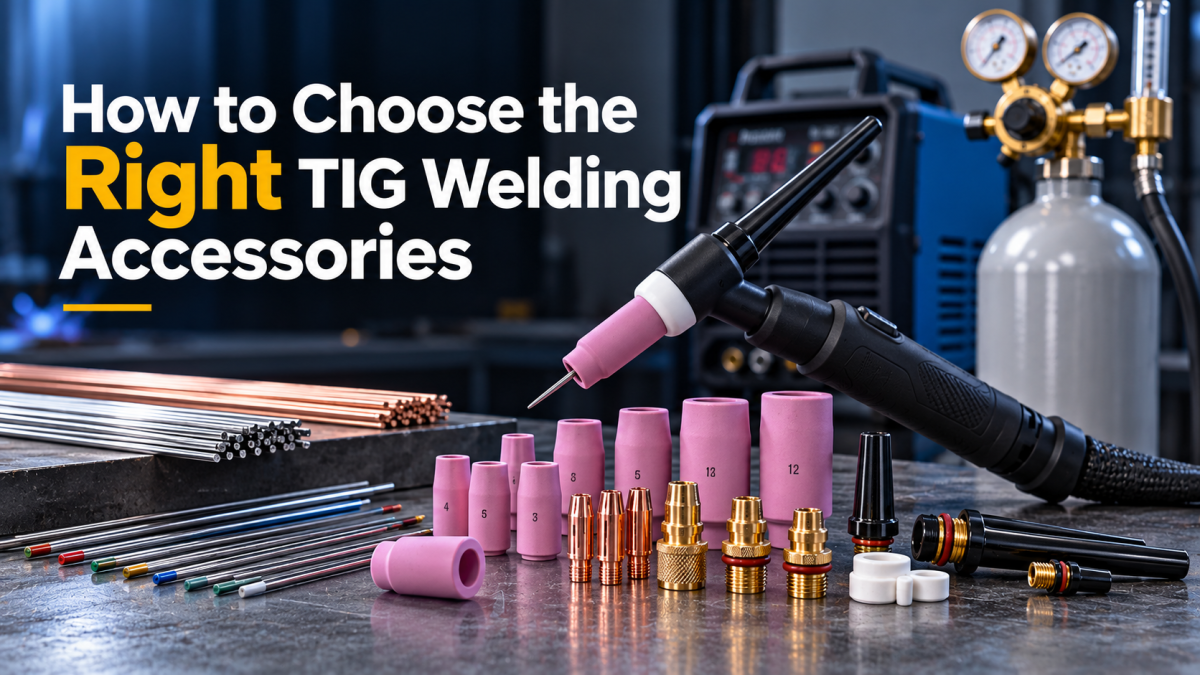
TIG welding is widely used when high weld quality, precision and excellent weld appearance are required. It is commonly used for stainless steel, aluminium, mild steel and other metals in fabrication, manufacturing, maintenance and precision welding applications.
While choosing the right TIG welding machine is important, the accessories used with the machine also have a major impact on welding performance.
The correct combination of TIG torch, tungsten electrode, collet, collet body, gas lens, ceramic cup, shielding gas regulator and filler rod can help improve arc stability, shielding gas coverage and overall weld quality.
1. Choose the Correct TIG Welding Torch
TIG torch is one of the most important components in a TIG welding setup. It carries the welding current and shielding gas while allowing the operator to control the tungsten electrode and welding arc.
When selecting a TIG torch, consider:
- Welding current rating
- Duty cycle
- Air-cooled or water-cooled design
- Torch size and ergonomics
- Torch length
- Connection type
- Welding application
Air-Cooled TIG Torch
Air-cooled torches are commonly used for light to medium-duty TIG welding applications. They are generally simpler to maintain and do not require a separate water-cooling system.
Water-Cooled TIG Torch
Water-cooled torches are designed for higher-current and longer-duration welding applications. They can provide better cooling when the torch is exposed to prolonged welding at higher current levels.
The torch should always be selected according to the welding current, duty cycle and application.
2. Select the Correct Tungsten Electrode
The tungsten electrode is one of the most important TIG welding consumables because it creates and maintains the welding arc. Tungsten electrodes are available in different types and sizes.
Common tungsten electrode diameters include:
- 1.0 mm
- 1.6 mm
- 2.0 mm
- 2.4 mm
- 3.2 mm
- 4.0 mm
The appropriate diameter depends on factors such as:
- Welding current
- Material type
- Material thickness
- AC or DC welding
- Welding application
Why tungsten selection matters
Using an unsuitable tungsten can result in:
- Unstable arc
- Difficulty starting the arc
- Excessive tungsten wear
- Tungsten contamination
- Poor weld appearance
Always refer to the welding machine and tungsten manufacturer’s recommended current range.
3. Choose the Correct Tungsten Type
Different tungsten electrode types are available for different TIG applications.
Common types include:
- Pure Tungsten
Traditionally associated with AC welding applications, particularly aluminium. However, modern TIG systems commonly use other tungsten types as well, depending on the manufacturer’s recommendations. - 2% Lanthanated Tungsten
Lanthanated tungsten is widely used for both AC and DC applications and provides good arc starting and stability.It is a versatile option for many TIG welding applications.
- 2% Ceriated Tungsten
Ceriated tungsten is commonly used for lower-current applications and can provide good arc-starting characteristics. - 2% Thoriated Tungsten
Thoriated tungsten has traditionally been widely used for DC TIG welding because of its arc-starting and current-carrying characteristics. Because it contains radioactive thorium, users should follow applicable workplace safety requirements when grinding and handling it.The best tungsten type depends on the welding machine, material and application.
4. Select the Correct Collet
The collet holds the tungsten electrode securely inside the TIG torch. Collets are available in different sizes according to the tungsten diameter.
The collet must match the tungsten diameter and be compatible with the TIG torch system.
A worn or damaged collet may prevent the tungsten from being held securely and can affect arc stability.
5. Choose the Right Collet Body
The collet body works together with the collet to secure the tungsten electrode inside the torch. It also provides the gas path toward the ceramic cup.
When choosing a collet body, check:
- Tungsten diameter
- TIG torch model
- Thread specification
- Standard or gas-lens design
Using a compatible collet body helps ensure proper tungsten positioning and shielding-gas flow.
6. Consider Using a Gas Lens
A gas lens is an important TIG accessory that can improve shielding gas distribution around the tungsten and weld zone. Compared with a standard collet body, a gas lens uses a diffuser to create a smoother and more uniform gas flow.
Gas lenses can be particularly useful for:
- Stainless steel welding
- Aluminium welding
- Precision welding
- Pipe welding
- Applications requiring better gas coverage
- Welding with longer tungsten stick-out
A gas lens can also make it easier to see the weld area because larger ceramic cups can sometimes be used with the setup.
However, the correct gas flow and torch setup are still essential. A gas lens does not compensate for incorrect shielding-gas settings or poor torch technique.
7. Select the Correct Ceramic Cup
The ceramic cup directs shielding gas around the tungsten electrode and weld pool. TIG cups are available in different sizes and shapes. Common cup sizes are often identified by numbers, although the exact dimensions can vary between manufacturers.
A larger cup can provide a wider shielding area, while a smaller cup can provide better access in tight welding areas.
When choosing a ceramic cup, consider:
- Welding application
- Tungsten diameter
- Gas lens or standard collet body
- Required gas coverage
- Joint accessibility
- Torch compatibility
The ceramic cup should also be kept clean and free from cracks.
A damaged cup can affect shielding gas coverage and should be replaced.
8. Choose the Correct TIG Torch Back Cap
The back cap secures the rear of the tungsten electrode inside the TIG torch.
Different back-cap lengths are available, including:
- Long back caps
- Medium back caps
- Short back caps
A short back cap can be useful when welding in confined spaces, while a longer back cap provides additional protection for the rear of the tungsten. The back cap must be compatible with the TIG torch and collet system.
9. Select the Correct Shielding Gas Regulator
Shielding gas is essential for protecting the tungsten electrode and molten weld pool from atmospheric contamination.
Common TIG shielding gases include:
- Argon
- Argon/helium mixtures
- Helium
- Other application-specific gas mixtures
For many TIG welding applications, argon is widely used because it provides good arc-starting characteristics and stable arc performance.
The regulator or flowmeter should be compatible with the gas being used and the cylinder connection.
Regulator vs Flowmeter
- A pressure regulator reduces the high pressure inside the gas cylinder.
- A flowmeter allows the operator to monitor and control gas flow to the TIG torch.
Too little shielding gas
May cause:
- Porosity
- Oxidation
- Discoloration
- Tungsten contamination
- Poor weld appearance
Too much shielding gas
Excessive gas flow can create turbulence, which may disturb the shielding around the weld pool. Therefore, the correct gas flow should be selected according to the torch, nozzle size, gas lens and welding application.
10. Choose the Correct TIG Filler Rod
TIG welding can be performed with or without filler material depending on the joint and application. When filler rod is required, it should be selected according to the base material and required weld properties.
Common TIG filler materials include:
- Mild steel
- Stainless steel
- Aluminium
- Aluminium-silicon alloys
- Aluminium-magnesium alloys
- Nickel alloys
- Other specialized alloys
Filler rod diameter should also be appropriate for the joint and material thickness. For example, thinner materials generally require smaller filler rods, while thicker joints may require larger filler material.
Always follow the applicable welding procedure or filler manufacturer’s recommendations.
11. Don’t Forget the Foot Pedal or Remote Control
For TIG welding machines equipped with remote-control capability, a foot pedal or hand remote can provide additional control over welding current.
This can be particularly useful when welding:
- Thin materials
- Aluminium
- Components with varying joint geometry
- Precision welds
- Applications requiring current adjustment during welding
A foot pedal allows the welder to increase or decrease welding current while maintaining torch position. Before purchasing one, make sure the remote control is compatible with the TIG welding machine.
12. Choose the Correct Welding Cable and Earth Clamp
A TIG welding system also requires a suitable work-return cable and earth clamp. The cable should be appropriately rated for the welding current and duty cycle. The earth clamp should provide a secure electrical connection to the workpiece.
Poor electrical connections can result in:
- Unstable arc
- Difficult arc starting
- Excessive heat at the connection
- Inconsistent welding performance
Always make sure the workpiece and connection area are clean before welding.
Common Mistakes When Choosing TIG Accessories
- Using wrong tungsten diameter
- Mixing incompatible torch components
- Ignoring gas lens
- Using wrong shielding gas flow
- Using damaged ceramic cup
- Choosing accessories based only on price
Conclusion
Choosing the right TIG welding accessories is essential for achieving stable arc performance, proper shielding and consistent weld quality.
The correct combination of TIG torch, tungsten electrode, collet, collet body, gas lens, ceramic cup, shielding gas regulator and filler rod can make a significant difference to the welding process.
For workshops, fabricators and industrial users, selecting compatible and quality TIG consumables can also help reduce downtime and maintain reliable welding performance.
Need help choosing the right TIG welding accessories?
Contact Weldmart with your TIG welding machine model, torch model, tungsten size, material and welding application. Our team can help you identify suitable TIG accessories and consumables for your welding setup.
Tel: +605-3665621 / +6019-3132353
Email: info@weldmart.com.my
Address: No. 3 & 3A, Persiaran Batu Gajah Perdana 7,
Pusat Komersial Batu Gajah Perdana 7,
31550 Pusing, Perak