
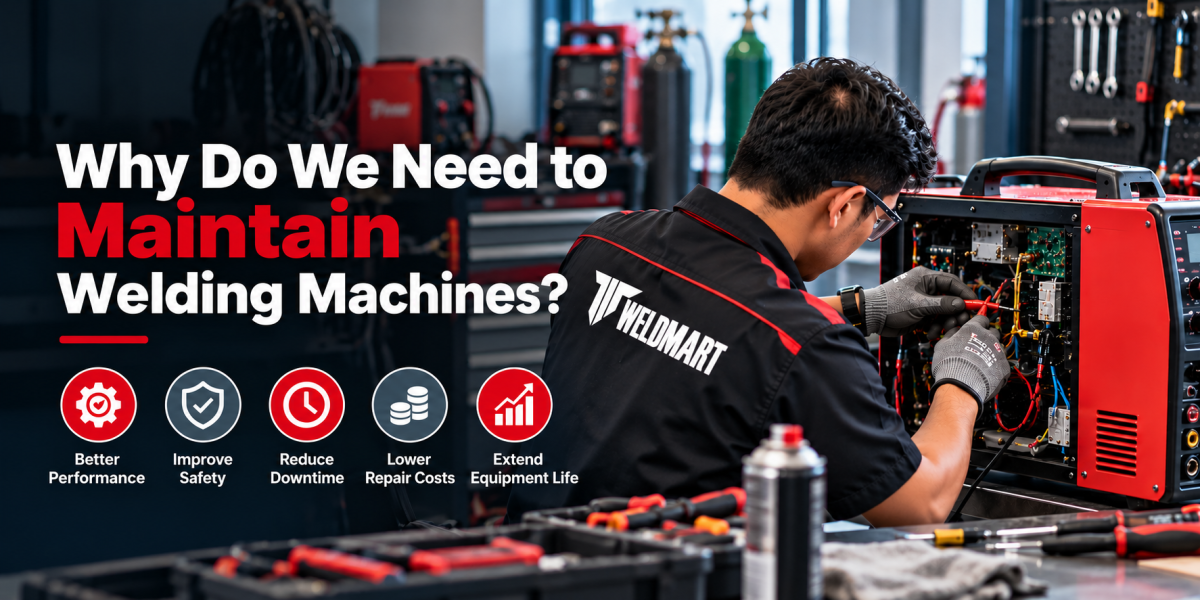
Welding machines are essential equipment in workshops, manufacturing facilities, fabrication companies, and technical training centres. Like any industrial equipment, welding machines require regular maintenance to ensure reliable performance, consistent welding quality, and safe operation.
However, welding machine maintenance is often overlooked until a problem occurs.
A machine may continue to operate even when its internal components are dirty, connections are loose, cooling systems are blocked, or cables and accessories are showing signs of wear. Over time, these issues can lead to poor welding performance, unexpected breakdowns, production downtime, and expensive repairs.
This is why preventive maintenance for welding machines should be part of every workshop’s equipment management plan.
Why is Welding Machine Maintenance Important?
Regular maintenance helps ensure that a welding machine continues to operate safely and efficiently. More importantly, it allows potential problems to be identified before they become major equipment failures.
Here are some of the key reasons why welding machine maintenance is important.
1. Maintain Consistent Welding Quality
Welding quality depends heavily on stable and accurate welding parameters. Issues such as unstable output current, damaged cables, poor connections, overheating, or malfunctioning components can affect the welding arc and result in inconsistent welds.
Regular inspection and maintenance help ensure that the welding machine continues to deliver stable performance. This is especially important for businesses where welding quality must meet specific production, inspection, or quality requirements.
2. Reduce Unexpected Machine Breakdown
One of the biggest problems caused by poor maintenance is unexpected equipment failure.
A welding machine may appear to be working normally until a critical component fails. When this happens, production or training activities may have to stop while waiting for troubleshooting, spare parts, or repair.
Preventive maintenance allows technicians to identify potential problems early.
Instead of waiting for a machine to fail, regular inspections can help identify:
- Loose electrical connections
- Damaged cables and connectors
- Cooling system problems
- Excessive dust accumulation
- Abnormal noise or overheating
- Worn components
- Unstable output performance
Early detection can significantly reduce the risk of unexpected downtime.
3. Extend the Service Life of Welding Equipment
Welding machines are a significant investment for many businesses and training centres.
Proper maintenance can help protect this investment by reducing unnecessary stress and wear on critical components.
For example, excessive dust inside a machine can affect cooling and ventilation. Poor cooling can cause components to operate at higher temperatures, potentially shortening their service life.
Regular cleaning, inspection, and preventive maintenance help keep the equipment operating under better conditions.
4. Improve Workplace Safety
Welding involves high electrical currents, heat, sparks, and other workplace hazards. A welding machine that is poorly maintained can create additional safety risks.
Regular inspection can help identify issues such as:
- Damaged power cables
- Damaged welding leads
- Loose electrical connections
- Faulty switches
- Poor grounding or earthing
- Overheating
- Damaged connectors
- Abnormal machine operation
Maintenance should always be carried out by competent personnel and according to the manufacturer’s recommendations and applicable safety requirements.
5. Minimize Downtime and Repair Costs
Reactive maintenance means repairing equipment after it breaks down.
Preventive maintenance takes a different approach: equipment is inspected and serviced before a major failure occurs.
Although preventive maintenance requires some planning and service costs, it can help reduce the financial impact of:
Unexpected breakdown → Emergency repair → Production downtime → Lost productivity
A planned maintenance schedule is generally easier to manage than an unexpected machine failure during an important production job or training session.
What Should Be Checked During Welding Machine Maintenance?
The exact maintenance procedure depends on the type and model of welding machine. However, a typical inspection may include several important areas.
- Electrical Connections
Electrical connections should be inspected for looseness, damage, corrosion, or signs of overheating. Loose connections can affect machine performance and may create safety concerns. Welding Cables and Connectors
Welding leads, electrode holders, MIG torches, TIG torches, connectors, and grounding cables should be inspected regularly. Damaged cables or connectors should be repaired or replaced when necessary.Cooling and Ventilation System
Many welding machines rely on fans and ventilation systems to control operating temperature. Dust and debris can restrict airflow and reduce cooling efficiency. Keeping ventilation areas clean can help prevent overheating and maintain reliable operation.Machine Exterior and Internal Condition
The machine should be checked for excessive dust, contamination, physical damage, and signs of abnormal operation. For suitable equipment, qualified technicians may also inspect internal components as part of scheduled servicing.Welding Output and Performance
The machine’s welding performance should be checked to identify unusual output behaviour, unstable arc characteristics, or other signs that may indicate a technical problem. Where applicable, measurement and verification equipment may be used to check machine performance.Accessories and Consumable-Related Components
Maintenance should not focus only on the main welding machine. Torches, cables, connectors, earth clamps, wire feeding systems, and other related components can also affect welding performance.
How Often Should a Welding Machine Be Serviced?
There is no single maintenance schedule that applies to every welding machine.
The appropriate frequency depends on factors such as:
- Machine type and model
- Frequency of use
- Operating environment
- Workshop conditions
- Dust and contamination levels
- Number of operators
- Production requirements
- Manufacturer recommendations
A machine used heavily in a production environment may require more frequent inspection than a machine used occasionally.
For training centres, where multiple students may use equipment every day, regular inspection can also help identify wear and equipment issues before they affect training activities.
The important thing is to have a planned maintenance schedule rather than waiting for the machine to fail.
Why Professional Welding Machine Maintenance Matters
Basic cleaning and visual inspection can be performed as part of routine equipment care. However, professional servicing may be required for more detailed inspection, troubleshooting, performance verification, calibration-related checks, or machine validation.
A professional service team can help identify problems that may not be obvious during normal operation.
This becomes particularly important for:
- Manufacturing facilities
- Welding workshops
- Fabrication companies
- Technical training centres
- TVET institutions
- Industrial training facilities
- Companies operating multiple welding machines
Instead of treating maintenance as an emergency activity, organisations can manage it as part of their overall equipment management strategy.
Keep Your Welding Equipment Performing at Its Best with Weldmart
At Weldmart, we understand that welding equipment is more than just a machine. It is an important part of your daily production, training, and operational activities.
That is why Weldmart provides flexible After-Sales Service Packages designed to support different equipment usage and operational requirements.
Don’t Wait Until Your Welding Machine Breaks Down
Regular welding machine maintenance is not simply about repairing equipment when it stops working.
It is about preventing problems, maintaining performance, improving safety, reducing downtime, and protecting your investment.
A planned service schedule can give your team greater confidence that your welding equipment is ready when you need it.
Need professional welding machine maintenance and technical support?
Explore the Weldmart Service Package and choose the level of after-sales support that fits your operation.
Tel: +605-3665621 / +019-3132353
Email: info@weldmart.com.my
Address: No. 3 & 3A, Persiaran BG Perdana 7,
Pusat Komersial BG Perdana,
31550 Pusing, Perak