
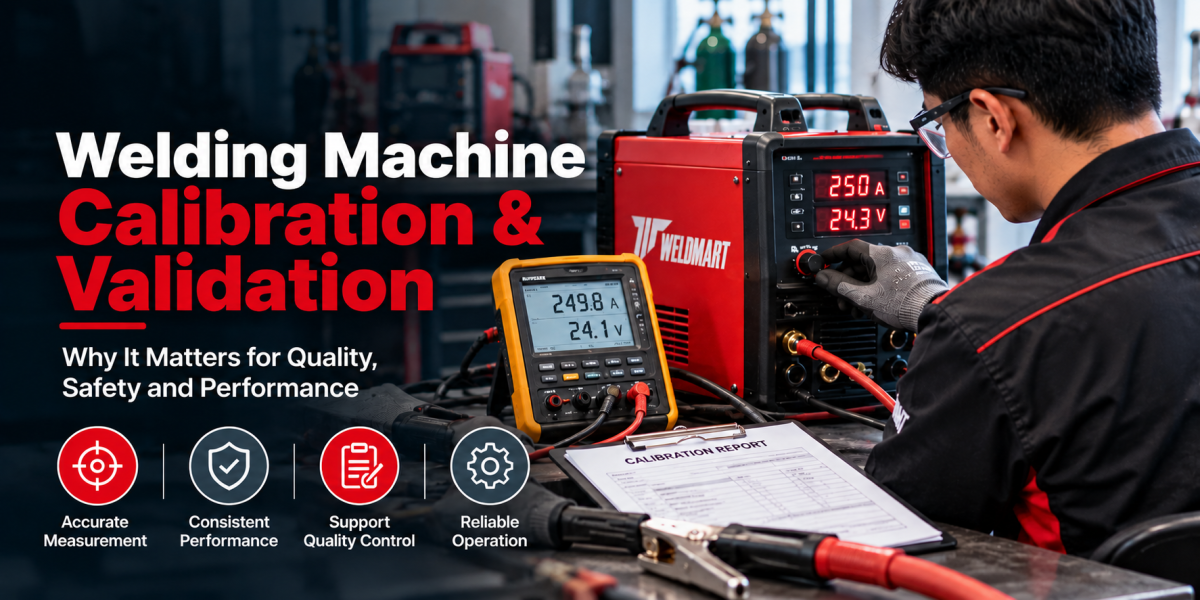
A welding machine may appear to be working normally, but how do you know that the actual welding output is accurate and performing according to the required specifications?
For workshops, manufacturing companies, fabrication facilities, and technical training centres, reliable welding equipment is important for maintaining consistent welding performance.
This is where calibration and validation become important.
Regular maintenance helps keep equipment in good working condition, while calibration and validation provide additional confidence that the equipment is performing and measuring as expected.
What is Welding Machine Calibration?
Calibration is the process of checking the accuracy of a measurement or output against a known reference or standard.
For welding equipment, calibration may involve checking parameters such as:
- Welding current
- Welding voltage
- Wire feed speed, where applicable
- Other measurable machine parameters depending on the equipment
The purpose is to determine whether the machine’s indicated or measured values are within the required accuracy or tolerance.
For example, if a welding machine is set to a particular current, calibration can help determine whether the actual output corresponds to the indicated setting within the applicable tolerance.
This is particularly important when welding parameters are required to be controlled and documented.
What is Welding Machine Validation?
While calibration focuses on measurement accuracy, validation is generally concerned with confirming that equipment is suitable and capable of performing its intended function under defined conditions.
In simple terms:
Calibration asks:
“Is the measurement or output accurate?”
Validation asks:
“Can the equipment consistently perform as required for its intended application?”
The exact validation process depends on the type of equipment, its intended use, applicable requirements, and the organization’s quality procedures.
For welding equipment, validation may involve checking machine performance against predefined requirements or operating criteria.
Calibration vs Validation: What is the Difference?
Although the terms are sometimes used together, calibration and validation serve different purposes.
| Calibration | Validation |
|---|---|
| Focuses on measurement accuracy | Focuses on intended performance |
| Compares values against a reference | Confirms equipment suitability or capability |
| Helps identify measurement deviation | Helps confirm equipment performs as required |
| Often involves measurement instruments | May involve equipment performance checks |
| Supports confidence in measured parameters | Supports confidence in equipment operation |
Both can play an important role in an effective welding equipment management programme.
Why Is Welding Machine Calibration Important?
1. Improve Confidence in Welding Parameters
Welding parameters such as current and voltage can have a significant influence on welding performance. If the actual output differs significantly from the indicated value, operators may unknowingly be working outside the intended parameter range.
Calibration helps provide confidence that the relevant measurements are accurate within the specified tolerance.
2. Support Consistent Welding Performance
Consistent welding requires controlled and repeatable parameters. When equipment performance is regularly checked, organizations can identify potential deviations before they develop into larger quality issues.
This is particularly useful for production environments where repeatability is important.
3. Support Quality Control
Many organisations have internal quality procedures requiring equipment to be inspected, verified, calibrated, or otherwise controlled.
Having appropriate calibration records can help organisations demonstrate that relevant equipment is being managed as part of their quality control process.
4. Identify Equipment Drift
Equipment performance can change over time because of:
- Frequent use
- Component ageing
- Environmental conditions
- Electrical issues
- Repairs or component replacement
- General wear and tear
Regular calibration can help identify changes in measured performance and determine whether further investigation or servicing is required.
Why is Welding Machine Validation Important?
Calibration alone does not necessarily tell you whether a machine is suitable for a particular application. A machine may have accurate measurement readings but still require further evaluation to confirm that it performs appropriately for its intended use.
Validation can therefore provide an additional level of confidence.
For example, organizations may want to confirm that equipment:
- Performs according to defined requirements
- Produces the required operating output
- Functions correctly after servicing or repair
- Is suitable for its intended application
- Continues to perform within defined acceptance criteria
The validation approach should be based on the equipment, application, manufacturer’s recommendations, and relevant organizational or industry requirements.
When Should a Welding Machine Be Calibrated or Validated?
The appropriate frequency depends on several factors and should be determined according to the equipment manufacturer’s recommendations, applicable requirements, usage, and the organization’s quality system.
Calibration or validation may be considered:
- After Major Repair
If important components have been repaired or replaced, checking equipment performance can help confirm that the machine is operating correctly. - After Long-Term Heavy Usage
Frequently used welding machines may require more regular performance checks depending on their operating environment and quality requirements. - When Unusual Performance Is Observed
If operators notice unstable output, unusual machine behaviour, or differences between expected and actual performance, the equipment should be investigated. - As Part of a Scheduled Quality Programme
Organizations with formal equipment control procedures may establish periodic calibration and validation schedules. - Before Important Production or Training Activities
For critical applications, verifying equipment condition and performance before use can provide additional confidence in the equipment.
What Happens During a Calibration or Validation Service?
The exact procedure depends on the machine model and the scope of service required.
A typical service process may include:
1. Equipment Identification
The equipment is identified and its relevant details are recorded, such as:
- Machine model
- Serial number
- Equipment type
- Location
- Service history, where available
2. Initial Inspection
The equipment may be visually inspected to identify obvious physical, electrical, or operational issues.
3. Parameter Checking
Relevant machine parameters are checked using appropriate measurement equipment and procedures.
4. Performance Verification
Measured results are compared against the applicable requirements, specifications, tolerances, or acceptance criteria.
5. Validation Checks
Where validation is required, the equipment’s performance may be assessed against its intended operational requirements.
6. Documentation
Service findings and relevant results can be documented for equipment records and future reference. The exact scope should always be agreed based on the equipment, application, and required standard or procedure.
Weldmart Calibration & Validation Service
At Weldmart, our after-sales support goes beyond basic equipment maintenance. We also provide calibration verification and machine validation services for selected equipment, depending on the machine type, application, and service requirements.
Our service approach is designed to help workshops, industrial facilities, and training centres maintain greater confidence in the condition and performance of their equipment.
Protect Your Equipment. Verify Its Performance.
Welding equipment plays an important role in production, fabrication, and technical training. Keeping machines operational is important, but organisations may also need confidence that relevant equipment measurements and performance remain within defined requirements.
Maintenance keeps equipment running.
Calibration checks measurement accuracy.
Validation confirms intended performance.
If your organization operates welding machines, training equipment, or other welding-related systems that require regular technical support, Weldmart can help you develop an appropriate service approach based on your equipment and operational requirements.
Need Calibration or Validation Support?
Talk to Weldmart about your welding equipment maintenance, calibration verification, and machine validation requirements.
Tel: +605-3665621 / +6019-3132353
Email: info@weldmart.com.my
Address: No. 3 & 3A, Persiaran BG Perdana 7,
Pusat Komersial BG Perdana,
31550 Pusing, Perak