
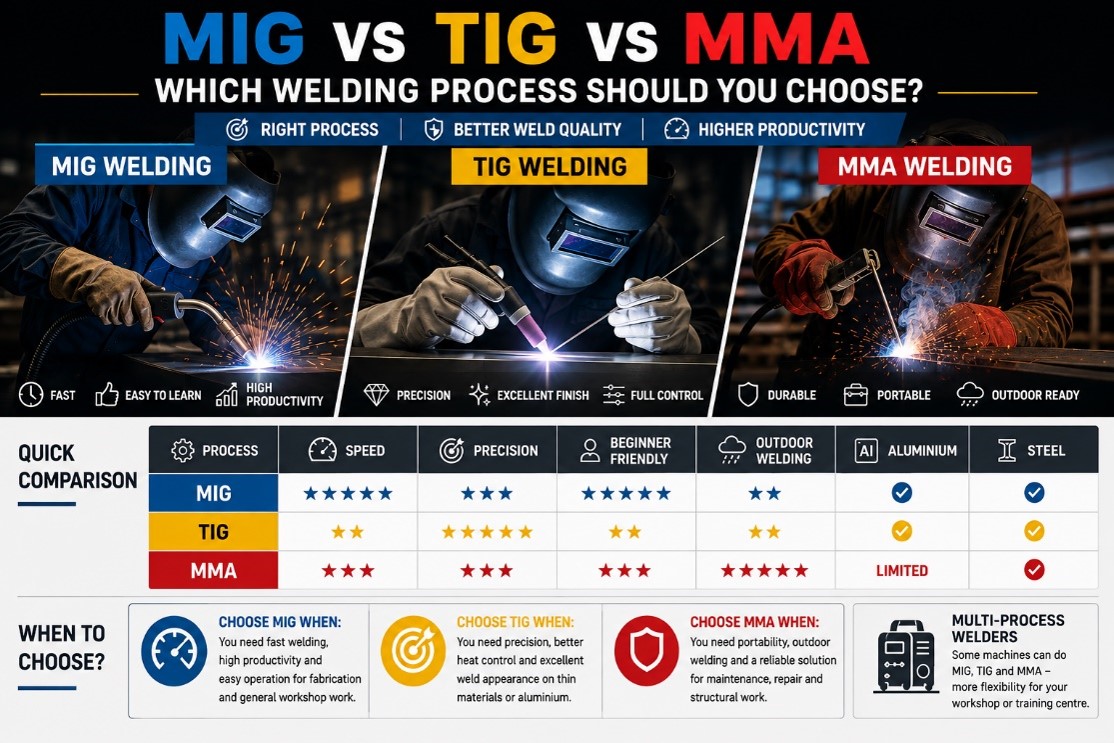
Choosing the right welding process can make a big difference in weld quality, productivity, cost and ease of operation. The three most common welding processes used in workshops, fabrication and training are MIG welding, TIG welding and MMA welding.
But which one is right for your application?
What is MIG Welding?
MIG welding, or Metal Inert Gas welding, is commonly associated with Gas Metal Arc Welding (GMAW).
MIG welding uses a continuously fed wire electrode and shielding gas to protect the weld area. Because the wire is automatically fed through the welding gun, MIG welding can offer high productivity and relatively easy operation.
Advantages of MIG Welding
- Fast welding speed
- Continuous wire feeding
- Good productivity
- Relatively easy to learn
- Suitable for fabrication and manufacturing
- Suitable for mild steel and stainless steel
- Can be used for aluminium with the appropriate setup
Common MIG Welding Applications
MIG welding is widely used for:
- Metal fabrication
- Automotive repair
- Manufacturing
- Workshop applications
- Structural fabrication
- General maintenance
Choose MIG welding when speed, productivity and ease of operation are important.
What is TIG Welding?
TIG welding, or Tungsten Inert Gas welding, is technically known as Gas Tungsten Arc Welding (GTAW).
TIG welding uses a non-consumable tungsten electrode to produce the arc. Filler metal can be added separately when required.
TIG provides excellent control over the welding arc and heat input, making it suitable for applications where precision and weld appearance are important.
Advantages of TIG Welding
- Excellent weld control
- High-quality weld appearance
- Excellent for thin materials
- Suitable for stainless steel
- Excellent for aluminium with suitable equipment
- Low spatter
- Suitable for precision welding
Common TIG Welding Applications
TIG welding is commonly used for:
- Stainless steel fabrication
- Aluminium welding
- Thin sheet metal
- Precision components
- Automotive applications
- High-quality fabrication
Choose TIG welding when precision, control and weld appearance are more important than welding speed.
What is MMA Welding?
MMA welding, also known as Manual Metal Arc welding or Stick Welding, uses a flux-coated consumable electrode.
Unlike conventional MIG and TIG welding, MMA does not require an external shielding gas because the electrode coating produces shielding during welding.
This makes MMA particularly useful for outdoor welding, maintenance and repair work.
Advantages of MMA Welding
- Simple equipment setup
- Highly portable
- Suitable for outdoor welding
- No conventional shielding gas required
- Suitable for maintenance and repair
- Good for structural steel applications
- Suitable for many steel welding applications
Common MMA Welding Applications
MMA welding is commonly used for:
- Construction
- Structural steel
- Maintenance and repair
- Outdoor welding
- Agricultural equipment
- General workshop repair
Choose MMA welding when portability, outdoor capability and flexibility are important.
Which Welding Process is Best for Beginners?
For many beginners, MIG welding can be a good starting point because the welding wire is continuously fed through the gun, allowing the operator to focus on torch movement, travel speed and weld pool control.
However, MMA welding is also important because it teaches fundamental arc welding skills and is widely used in construction and maintenance.
TIG welding generally requires more coordination and control, making it more suitable after the operator has developed basic welding skills.
For TVET institutions and welding training centres, teaching MIG, TIG and MMA can give students broader practical skills and better exposure to different industrial applications.
Which Welding Machine Should You Choose?
Before purchasing a welding machine, consider:
1. Material
Are you welding mild steel, stainless steel, aluminium or other materials?
2. Material Thickness
Thin materials may require better heat control, while thicker materials may require higher welding current and appropriate joint preparation.
3. Welding Environment
For outdoor applications, MMA can be advantageous because it does not depend on external shielding gas.
4. Productivity
For high-volume fabrication, MIG welding can provide higher productivity than TIG.
5. Weld Quality
For applications where precision and appearance are critical, TIG can be the preferred option.
6. Training Requirements
For TVET and training centres, consider the welding processes required by the training programme and industry requirements.
For workshops and TVET training centres, having access to MIG, TIG and MMA welding equipment can provide greater flexibility and allow students or operators to develop a wider range of welding skills.
Looking for Welding Machines in Malaysia?
Choosing the right welding machine depends on more than just selecting MIG, TIG or MMA. Factors such as application, material, thickness, welding current, duty cycle, power supply and operator skill level should also be considered.
Weldmart provides welding equipment and training solutions for industries, workshops, universities, TVET institutions and training centres in Malaysia.
Our solutions include:
- MIG/MAG welding machines
- TIG welding machines
- MMA welding machines
- Multi-process welding machines
- Welding training equipment
- Welding simulators
- Fume extraction systems
- Welding workshop equipment
If you are planning to set up or upgrade a welding workshop or training centre, contact Weldmart for assistance in selecting the right welding equipment for your requirements.
Need help choosing between MIG, TIG and MMA? Contact Weldmart for a suitable welding equipment recommendation or quotation.
Tel: +605-3665621 / +6019-3132353
Email: info@weldmart.com.my
Address: No. 3 & 3A, Persiaran Batu Gajah Perdana 7,
Pusat Komersial Batu Gajah Perdana,
31550 Pusing, Perak